<?xml version="1.0" encoding="utf-8"?><feed xmlns="http://www.w3.org/2005/Atom" ><generator uri="https://jekyllrb.com/" version="3.10.0">Jekyll</generator><link href="https://edmhill.github.io/feed.xml" rel="self" type="application/atom+xml" /><link href="https://edmhill.github.io/" rel="alternate" type="text/html" /><updated>2026-05-21T20:32:01+01:00</updated><id>https://edmhill.github.io/feed.xml</id><title type="html">Ed Hill</title><subtitle>Researcher in Mathematical Epidemiology and Infectious Disease Modelling</subtitle><author><name>Ed Hill</name><email>Edward.Hill@liverpool.ac.uk</email></author><entry><title type="html">SBIDER Podcast Hub</title><link href="https://edmhill.github.io/posts/SBIDER_podcast_hub/" rel="alternate" type="text/html" title="SBIDER Podcast Hub" /><published>2022-11-22T00:00:00+00:00</published><updated>2022-11-22T00:00:00+00:00</updated><id>https://edmhill.github.io/posts/SBIDER_podcast_hub</id><content type="html" xml:base="https://edmhill.github.io/posts/SBIDER_podcast_hub/"><![CDATA[<!-- <figure>
  <img src="/images/CCS2019/featured.png" alt=""/>
</figure> -->

<h3 id="genesis-of-the-sbider-podcast-hub">Genesis of the SBIDER Podcast Hub</h3>
<p>In March 2022, myself and my colleague at SBIDER <a href="https://uk.linkedin.com/in/laura-guzman-rincon" target="_blank">Laura Guzmán Rincón</a> had an ambition. We wanted to develop a collection of podcast shows to broaden the forms of media <a href="https://warwick.ac.uk/fac/cross_fac/zeeman_institute/" target="_blank">The Zeeman Institute for Systems Biology &amp; Infectious Disease Epidemiology Research (SBIDER)</a> group could use to share with the public both scientific research and our experiences working in an academic research group.</p>

<p>These goals had arisen thanks to the <a href="https://gateway.newton.ac.uk/ramp" target="_blank">RAMP (Rapid Assistance for Modelling the Pandemic)</a> Outreach Innovation Awards funding call.
We requested funds to purchase a podcast kit and supporting hardware, with a view that such capital expenditure would be an investment that can support engagement activities longer-term.</p>

<h3 id="ramp-outreach-innovation-award">RAMP Outreach Innovation Award</h3>
<p>RAMP Outreach Innovation Awards were granted to Early Career Researchers based in the UK in the field of infectious disease modelling to undertake projects with a significant outreach component. The projects had to include communication of infectious disease modelling concepts to the general public and/or the wider scientific community.</p>

<p>The outreach award encouraged a broad scope of outreach activities, with eligible activities including:</p>

<ul>
  <li>Develop and run training events for undergraduate students to deliver outreach talks or workshops in schools</li>
  <li>Create and publicise online public lectures</li>
  <li>Develop podcasts or websites</li>
  <li>Construct activities for science exhibitions</li>
  <li>Create citizen science projects</li>
  <li>Make online science outreach videos.</li>
</ul>

<p>Eight projects were awarded funding, with the SBIDER Podcast Hub being one of the eight successful applications. Updates from the funded projects are available via the <a href="https://gateway.newton.ac.uk/node/14343" target="_blank">INI Newton Gateway to Mathematics</a>.</p>

<h3 id="our-podcast-series">Our podcast series</h3>

<p>With the support of our RAMP Outreach Innovation Award (UKRI Grant EP/V053507/1), as of November 2022 we have developed two podcast series, <em>SBIDER presents</em> and the <em>SBIDER Careers Podcast</em>.</p>

<table>
  <tbody>
    <tr>
      <td><img src="/images/SBIDER_podcast_hub/SBIDER_presents_Logo.jpg" alt="First Image" /></td>
      <td><img src="/images/SBIDER_podcast_hub/SBIDER_careers_Logo.jpg" alt="Second Image" /></td>
    </tr>
  </tbody>
</table>

<h4 id="sbider-presents">SBIDER presents</h4>
<p>In <em>SBIDER presents</em> we interview researchers from SBIDER and its collaborators about their work in the biological and medical sciences. We also share recent news from the SBIDER group.</p>

<p>We endeavour to showcase how the research being conducted is achieving SBIDER’s aim of using mathematics to solve challenges in the biological and medical sciences, to better understand the biological world and often with the ultimate goal of controlling disease.</p>

<p>As of November 2022, we have released a trailer and three full episodes. Episodes of <em>SBIDER presents</em> are available on:</p>

<ul>
  <li><a href="https://sbiderpresents.podbean.com" target="_blank">Podbean</a></li>
  <li><a href="https://music.amazon.com/podcasts/1a1b46ed-1d62-4192-a113-cebc64a3153c/sbider-presents" target="_blank">Amazon music</a></li>
  <li><a href="https://podcasts.google.com/feed/aHR0cHM6Ly9mZWVkLnBvZGJlYW4uY29tL1NCSURFUnByZXNlbnRzL2ZlZWQueG1s" target="_blank">Google Podcasts</a></li>
  <li><a href="https://open.spotify.com/show/6UxK2dym56uVB1uDDjbu2K" target="_blank">Spotify</a></li>
  <li><a href="https://www.youtube.com/channel/UClxW6Ls3EA9R3evWjd8HjQg" target="_blank">YouTube</a></li>
  <li><a href="https://warwick.ac.uk/fac/cross_fac/zeeman_institute/podcasts/" target="_blank">SBIDER webpage</a></li>
</ul>

<h4 id="sbider-careers-podcast">SBIDER Careers Podcast</h4>
<p>What are the paths to a research career in epidemiology and infectious disease modelling? What are the day-to-day tasks? Who supports their research activities?</p>

<p>Targeted at those interested in research careers in epidemiology and mathematical modelling, the <em>SBIDER Careers Podcast</em> explores these questions by interviewing SBIDER researchers and research support staff who carry out important work that enables the research being conducted.</p>

<p>As of November 2022, we have released a trailer and five full episodes. Topics of conversation have so far ranged from postdoctoral research to project management to directing the research group.</p>

<p>Episodes of the <em>SBIDER Careers Podcast</em> are available on:</p>

<ul>
  <li><a href="https://sbidercareerspodcast.podbean.com" target="_blank">Podbean</a></li>
  <li><a href="https://music.amazon.com/podcasts/a113dd65-8ddd-4c67-962d-4d19140522ba/sbider-careers-podcast" target="_blank">Amazon music</a></li>
  <li><a href="https://podcasts.google.com/feed/aHR0cHM6Ly9mZWVkLnBvZGJlYW4uY29tL1NCSURFUkNhcmVlcnNQb2RjYXN0L2ZlZWQueG1s" target="_blank">Google Podcasts</a></li>
  <li><a href="https://open.spotify.com/show/5gPM2tNJoo2qu4yvjxtAb2" target="_blank">Spotify</a></li>
  <li><a href="https://www.youtube.com/channel/UClxW6Ls3EA9R3evWjd8HjQg" target="_blank">YouTube</a></li>
  <li><a href="https://warwick.ac.uk/fac/cross_fac/zeeman_institute/podcasts/" target="_blank">SBIDER webpage</a></li>
</ul>

<h3 id="future-plans">Future plans</h3>
<p>In the short-term, to close out 2022 we have one episode planned for release per series in December.</p>

<p>In <em>SBIDER presents</em>, we will be speaking with <a href="https://warwick.ac.uk/fac/sci/statistics/staff/academic-research/spencer" target="_blank">Dr Simon Spencer</a> about his research interest in fitting models to data and model comparison, with applications to epidemiology. The paper of focus will be a publication in the Annals of Applied Statistics titled “<a href="https://doi.org/10.1214/21-AOAS1486" target="_blank">Integrating geostatistical maps and infectious disease transmission models using adaptive multiple importance sampling</a>”.</p>

<p>For the <em>SBIDER Careers Podcast</em>, the next episode will feature a couple of SBIDER-affiliated PhD students and discuss PhD life as part of the <a href="https://warwick.ac.uk/fac/sci/mathsys/" target="_blank">Mathematics for Real-World Systems Centre for Doctoral Training</a>.</p>

<p>As we venture into 2023, a potential expansion to our audio portfolio would be a series that features visitors to SBIDER (seminar speakers, research exchanges for example).</p>]]></content><author><name>Ed Hill</name><email>Edward.Hill@liverpool.ac.uk</email></author><category term="Public Engagement" /><summary type="html"><![CDATA[]]></summary></entry><entry><title type="html">Pint of Science 2022</title><link href="https://edmhill.github.io/posts/PoS2022/" rel="alternate" type="text/html" title="Pint of Science 2022" /><published>2022-05-12T00:00:00+01:00</published><updated>2022-05-12T00:00:00+01:00</updated><id>https://edmhill.github.io/posts/PoS2022</id><content type="html" xml:base="https://edmhill.github.io/posts/PoS2022/"><![CDATA[<!-- <figure>
  <img src="/images/CCS2019/featured.png" alt=""/>
</figure> -->

<p>On 11 May 2022, myself and <a href="https://warwick.ac.uk/fac/sci/lifesci/people/mtildesley/" target="_blank">Mike Tildesley</a> from the <a href="https://warwick.ac.uk/fac/cross_fac/zeeman_institute/" target="_blank">SBIDER</a> group had the opportunity to present to the public at the 2022 edition of Pint of Science.</p>

<p>If you are interested in finding out more about Pint of Science and our experiences of contributing to this public engagement venture, then please read on!</p>

<h3 id="what-is-pint-of-science">What is Pint of Science?</h3>

<p><a href="https://pintofscience.co.uk" target="_blank">Pint of Science</a> is a global science festival that brings researchers to local venues to share their scientific research with the public.</p>

<p>A stated <a href="https://pintofscience.co.uk/about/" target="_blank">core value</a> of Pint of Science is
"to provide a space for researchers and members of the public alike to come together, be curious, and chat about research in a relaxed environment outside of mysterious laboratories or daunting dark lecture theatres".</p>

<p>For the 2022 edition, across the UK 31 towns/cities hosted events.</p>

<h3 id="what-was-the-theme-of-our-event">What was the theme of our event?</h3>
<p>The Pint of Science event we attended was part of the event series in <a href="https://pintofscience.co.uk/events/coventry" target="_blank">Coventry &amp; Warwickshire</a>. It brought together three researchers from the University of Warwick under the theme of  <a href="https://pintofscience.co.uk/event/our-amazing-body" target="_blank">Our Amazing Body</a>, to talk about the human body and how it works, and how we can help it work if needed.</p>

<p>Talks included how an individual’s own immune system could be used to destroy cancer cells from within, how understanding the way infections spread can help to limit their impact, and how a low-cost prosthetic can be engineered to provide touch sensation.</p>

<p>We were especially fortunate for our venue to be in the popular <a href="https://coventry2021.co.uk/explore/assembly-festival-garden/" target="_blank">Assembly Festival Gardens</a> in Coventry!</p>

<h3 id="what-did-we-speak-about">What did we speak about?</h3>
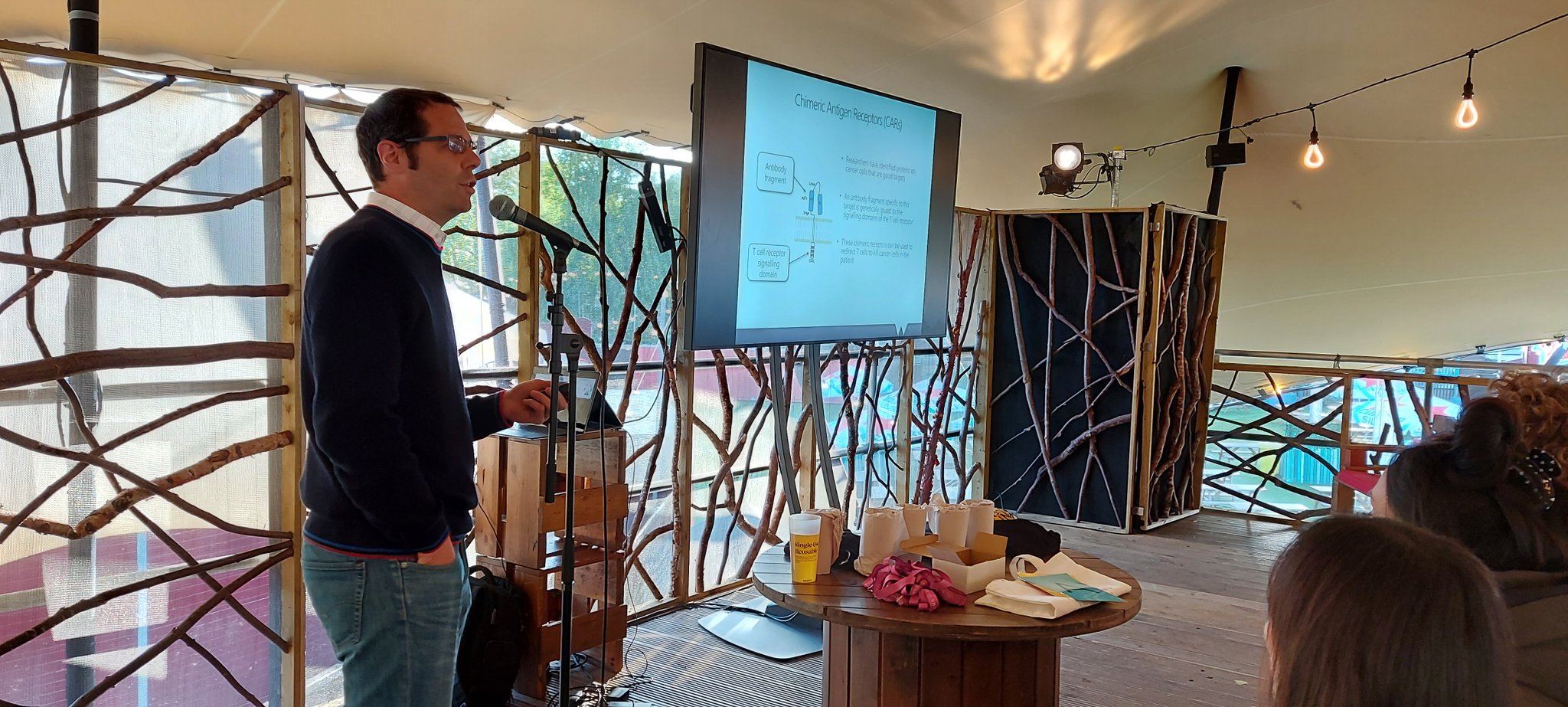
<p>Our talk was titled "Disease detectives: how maths can help us against disease outbreaks".</p>

<p>It is an unfortunate fact of life that there is an abundance of infectious diseases, negatively impacting public health and the livestock industry. To reduce the negative effects of an outbreak, epidemiologists look for information on where cases are, try to determine risk factors and ascertain how the infection may spread.</p>

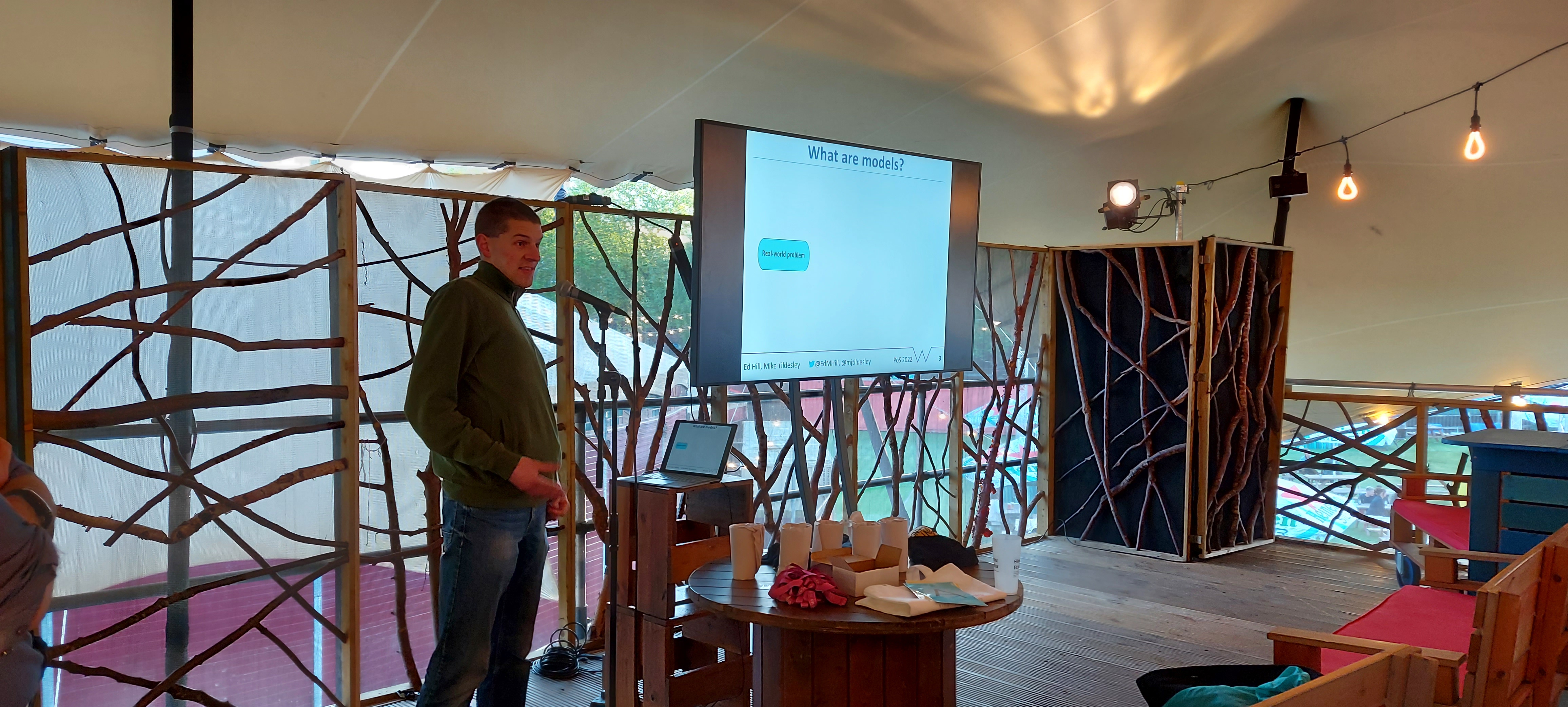
<figure>
  <img src="/images/pint_of_science_2022/20220511_195021.jpg" alt="" />
  <figcaption> Ed Hill presenting at Pint of Science 2022.
  </figcaption>
</figure>

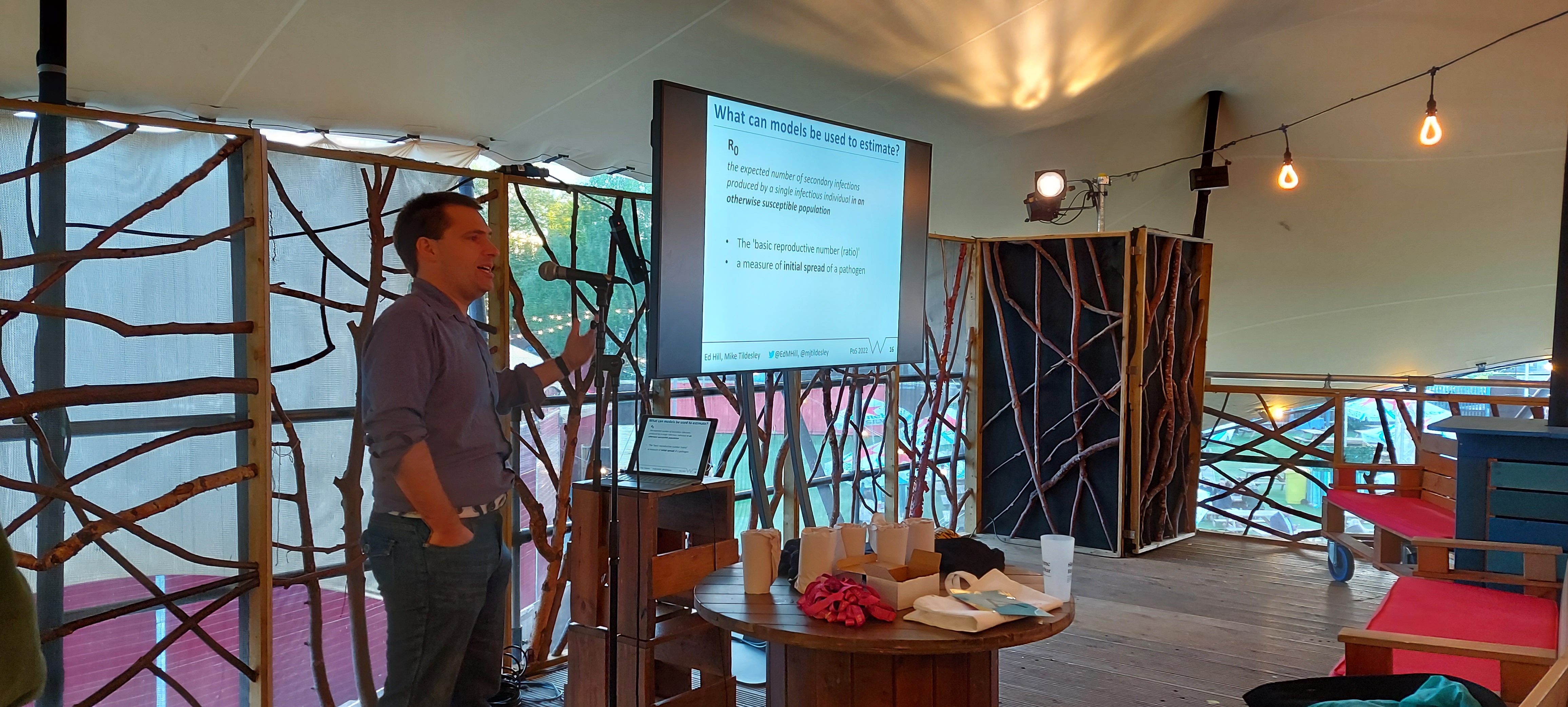
<p>Mathematical modelling is one tool for analysis that can help. The opening section of our talk discussed three questions: What are models? Why do we use models? What can models be used to estimate?</p>

<figure>
  <img src="/images/pint_of_science_2022/20220511_195740.jpg" alt="" />
  <figcaption> Mike Tildesley presenting at Pint of Science 2022.
  </figcaption>
</figure>

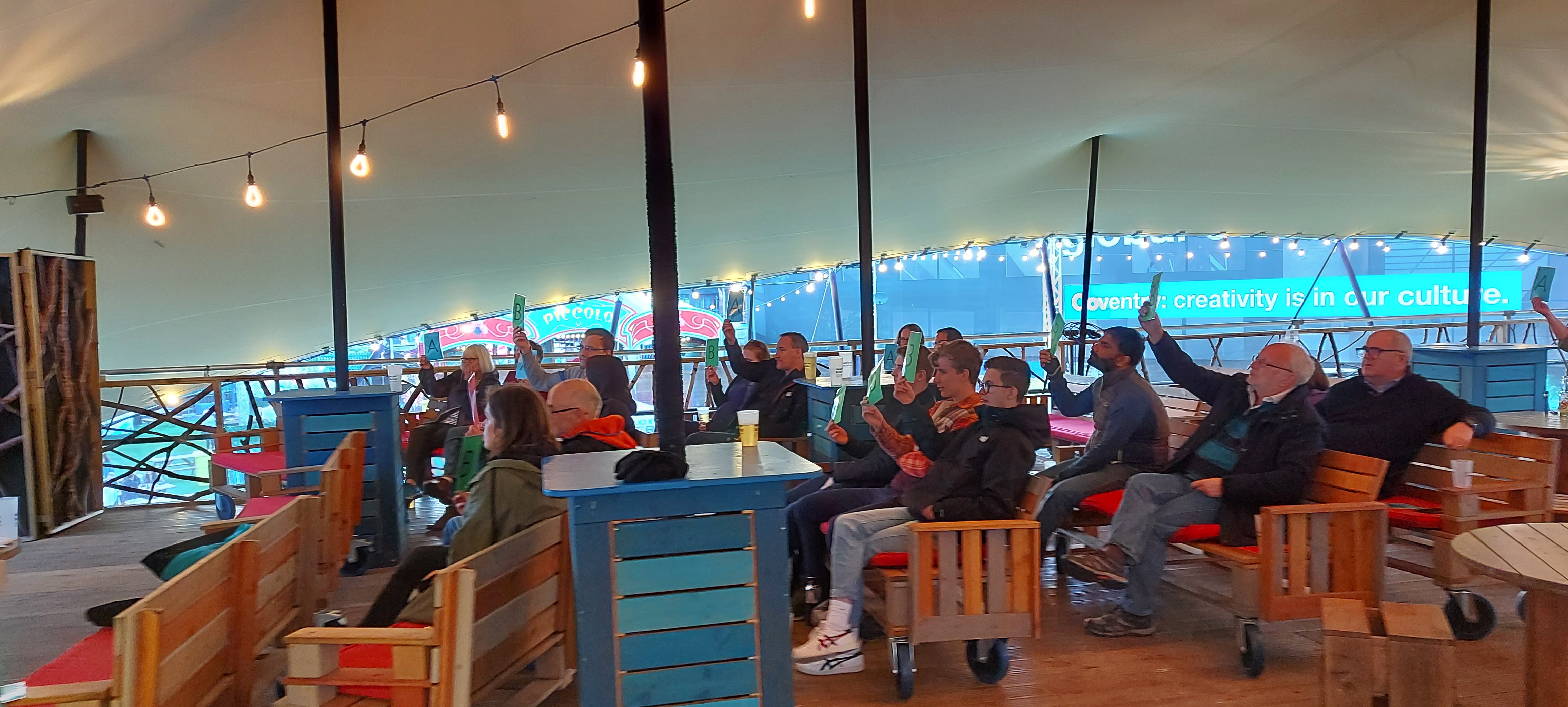
<p>Our concluding section gave a view into decision making in the presence of uncertainty. This included an interactive activity, putting the audience members in the role of a decision maker and asking them to vote between different intervention choices.</p>

<figure>
  <img src="/images/pint_of_science_2022/20220511_201246.jpg" alt="" />
  <figcaption> The audience votes during our Pint of Science 2022 talk.
  </figcaption>
</figure>

<p>You may download a PDF copy of our the presentation slides from our talk <a href="/files/TalkSlides/pint_of_science_11May2022.pdf" target="_blank">here</a>.</p>
<iframe src="/files/TalkSlides/pint_of_science_11May2022.pdf" width="100%" height="600" frameborder="no" border="0" marginwidth="0" marginheight="0"></iframe>

<h3 id="what-did-we-learn-about-in-the-other-talks">What did we learn about in the other talks?</h3>

<p>"Can our immune system be a personalised cancer cure?"
The question posed by <a href="https://warwick.ac.uk/fac/sci/med/qbp/pis/assistantprofessors/" target="_blank">John James</a>, Associate Professor at <a href="https://warwick.ac.uk/fac/sci/med/" target="_blank">Warwick Medical School</a> and the the first speaker of the evening.</p>

<p>John discussed why cancer is so difficult for the immune system to deal with and how new therapeutics are beginning to overcome this hurdle.</p>

<figure>
  <img src="/images/pint_of_science_2022/first_talk.jpeg" alt="" />
  <figcaption> John James presenting at Pint of Science 2022.
  </figcaption>
</figure>

<p>The final talk of the evening, "Enabling the future with affordable prosthetics" by <a href="https://twitter.com/manupautrejo" target="_blank">Manuela Trejo</a>, was also captivating. A researcher in engineering, Manuela develops upper limb prosthetics and the talk addressed the question of how can a low-cost prosthetic be engineered to fit a person’s needs and provide touch sensation?</p>

<p>Manuela also highlighted the amazing work being done by <a href="https://enablingthefuture.org" target="_blank">e-NABLE</a>, "an online global community of “Digital Humanitarian” volunteers from all over the world who are using their 3D printers to make free and low-cost prosthetic upper limb devices for children and adults in need".</p>

<h3 id="post-event-reflections">Post event reflections</h3>
<p>Overall, being able to present our research to the general public was very enjoyable! It was terrific to work together with the <a href="https://warwick.ac.uk/wie/" target="_blank">Warwick Institute of Engagement</a>, which helped us prepare our presentation and improve our interactive activities to ensure they were accessible to all. If you have ideas on conveying your research to a general audience, to hone the activity I would very much encourage getting in contact with groups who have practical engagement expertise.</p>]]></content><author><name>Ed Hill</name><email>Edward.Hill@liverpool.ac.uk</email></author><category term="Public Engagement" /><summary type="html"><![CDATA[]]></summary></entry><entry><title type="html">Conference on Complex Systems 2019: Co-organising a satellite session</title><link href="https://edmhill.github.io/posts/CCS2019/" rel="alternate" type="text/html" title="Conference on Complex Systems 2019: Co-organising a satellite session" /><published>2019-10-17T00:00:00+01:00</published><updated>2019-10-17T00:00:00+01:00</updated><id>https://edmhill.github.io/posts/CCS2019</id><content type="html" xml:base="https://edmhill.github.io/posts/CCS2019/"><![CDATA[<figure>
  <img src="/images/CCS2019/featured.png" alt="" />
</figure>

<p>Myself and two colleagues from the <a href="https://warwick.ac.uk/fac/cross_fac/zeeman_institute/" target="_blank">SBIDER</a> group (<a href="https://warwick.ac.uk/fac/sci/mathsys/people/students/2015intake/meakin/" target="_blank">Sophie Meakin</a> &amp; <a href="https://warwick.ac.uk/fac/sci/mathsys/people/students/2015intake/atkins/" target="_blank">Ben Atkins</a>, PhD students from the <a href="https://warwick.ac.uk/fac/sci/mathsys/" target="_blank">MathSys Centre for Doctoral Training</a>) recently returned from the annually run Conference on Complex Systems (CCS). Organised by the <a href="https://cssociety.org/home" target="_blank">Complex Systems Society</a>, CCS is the biggest and most important annual meeting of the international complex systems community. For the 2019 edition, CCS took place at <a href="http://www.ntu.edu.sg/Pages/home.aspx" target="_blank">Nanyang Technological University, Singapore</a> from 30th September - 4th October.</p>

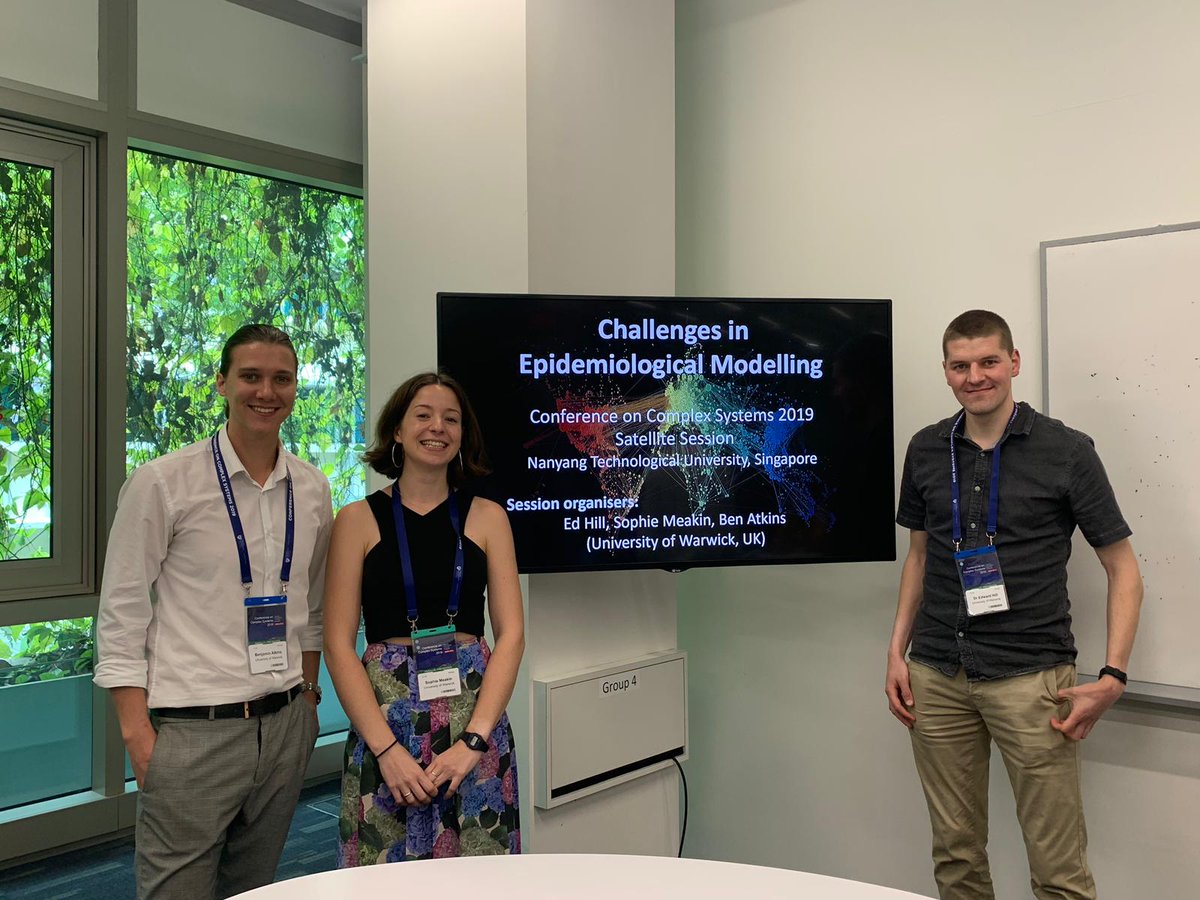
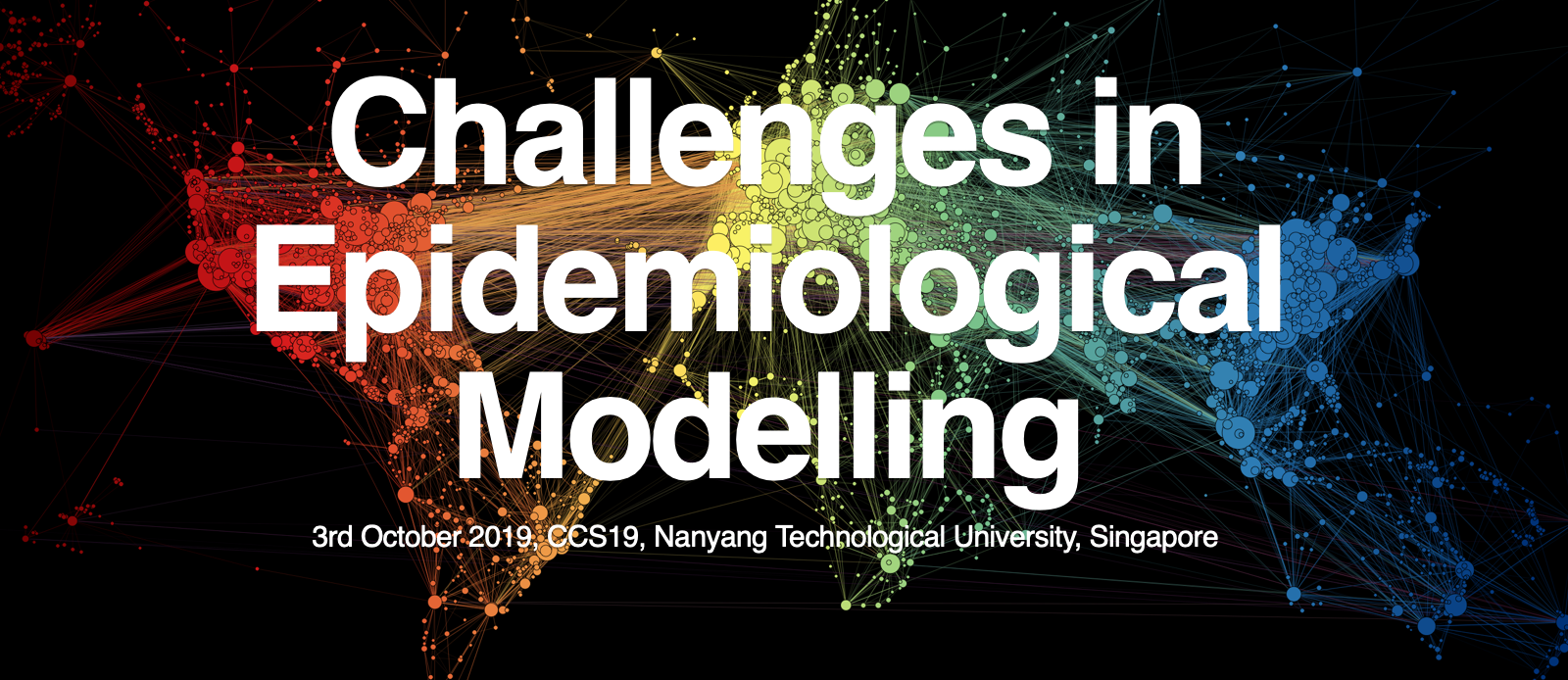
<p>In addition to each of us presenting a contributed talk as part of the main conference parallel sessions, the three of us co-organised a satellite session on <a href="https://cem-ccs19.github.io" target="_blank"><em>Challenges in Epidemiological Modelling</em></a>.</p>

<h3 id="what-is-a-satellite-session">What is a satellite session?</h3>

<p>At CCS, two days out of the five day long scientific programme are dedicated to satellite sessions. A satellite session is usually a half-day session or full-day session, with each satellite organised and managed by its own committee, responsible for reviewing proposed contributions and working with its presenters</p>

<h3 id="content-of-our-satellite-session">Content of our satellite session</h3>

<p>Our half-day satellite session focused on a broad range of challenges that arise in the context of epidemiological modelling, taking advantage of the wide range of disciplines present at CCS 2019. We seeked to stimulate discussion across disciplines regarding, but not limited too, issues with data collection and curation, methodology and computation and the gap between research and policy, for both public and veterinary health scenarios.</p>

<p>For an overview of the programme, please see the <a href="https://cem-ccs19.github.io/#schedule" target="_blank">event schedule</a>. As a brief overview, following a short introduction the session was opened by a keynote talk from <a href="https://www.epicx-lab.com/vittoria-colizza.html" target="_blank">Dr Vittoria Colliza</a> (<a href="https://www.inserm.fr/en" target="_blank">INSERM, French National Institute for Health and Medical Research</a>) on "How big does Big Data need to be? An epidemic modeling perspective.&amp;quot, followed by three short ignite style talks (5-10 minutes) and five long format talks (15 minutes + 5 minute Q&amp;A).</p>

<figure>
  <img src="/images/CCS2019/CEMteam.jpg" alt="CEM satellite session team photo" />
      <figcaption> The organising team for the Challenges in Epidemiological Modelling satellite session: (from left to right) Ben Atkins, Sophie Meakin, Ed Hill </figcaption>
</figure>

<h3 id="event-management">Event management</h3>

<p>Being a multi-person organisational team, to benefit efficiency we wanted to make use of centralised systems that would ensure we all had access to relevant information and that each of us would be able to update pieces such as the event webpage.</p>

<p>We highlight here a couple of resources we used to deliver the event: (i) <a href="https://easychair.org/overview" target="_blank">EasyChair</a> for managing abstract submissions and author correspondence; (ii) <a href="https://pages.github.com" target="_blank">GitHub Pages</a> for establishing a web presence for the event.</p>

<h4 id="easychair">EasyChair</h4>
<p><a href="https://easychair.org/overview" target="_blank">EasyChair</a> is a conference management system. The platform is designed to help conference/meeting organisers deal with the complexities associated with (but not limited to) collecting abstract submissions, manage the refereeing process (plus relaying of feedback to authors), sending emails to fellow organisers and authors, and production of the event programme and related materials.</p>

<p>For our satellite session, the features we utilised were soliciting abstracts and managing emails to authors.</p>

<h4 id="github-pages">GitHub Pages</h4>
<p><a href="https://pages.github.com" target="_blank">GitHub Pages</a> may be used to host a website directly from a <a href="https://github.com" target="_blank">GitHub repository</a>.</p>

<p>As described within the <a href="https://help.github.com/en/articles/about-github-pages" target="_blank">About GitHub Pages</a> section:</p>

<p>"GitHub Pages is a static site hosting service that takes HTML, CSS, and JavaScript files straight from a repository on GitHub, optionally runs the files through a build process, and publishes a website..&amp;quot</p>

<p>We used the user site variant to host <a href="https://cem-ccs19.github.io" target="_blank">our satellite session webpage</a>, though it should be noted that only one user site may be created for each GitHub account.</p>

<h3 id="post-event-reflections">Post event reflections</h3>
<p>We were pleased with the range of talks acquired, with speakers drawn from four continents. Additionally, we had encouraged participation from early career researchers and had been successful with our session contributors spanning the breadth of career stages.  It was also great to witness networking across groups post-session.</p>

<p>Going forward, aspects warranting revision if organising another scientific meeting would include attempting to schedule an invited speaker per segment (in other words, one invited speaker before the designated break and the other invited speaker afterwards). Such an amendment would provide balance to the programme in terms of spacing of contributions from established researchers.</p>]]></content><author><name>Ed Hill</name><email>Edward.Hill@liverpool.ac.uk</email></author><category term="CCS2019" /><category term="conference" /><summary type="html"><![CDATA[]]></summary></entry><entry><title type="html">SMB 2019</title><link href="https://edmhill.github.io/posts/SMB2019/" rel="alternate" type="text/html" title="SMB 2019" /><published>2019-07-28T00:00:00+01:00</published><updated>2019-07-28T00:00:00+01:00</updated><id>https://edmhill.github.io/posts/SMB2019post</id><content type="html" xml:base="https://edmhill.github.io/posts/SMB2019/"><![CDATA[<figure>
  <img src="/images/SMB2019/featured.jpg" alt="" />
</figure>

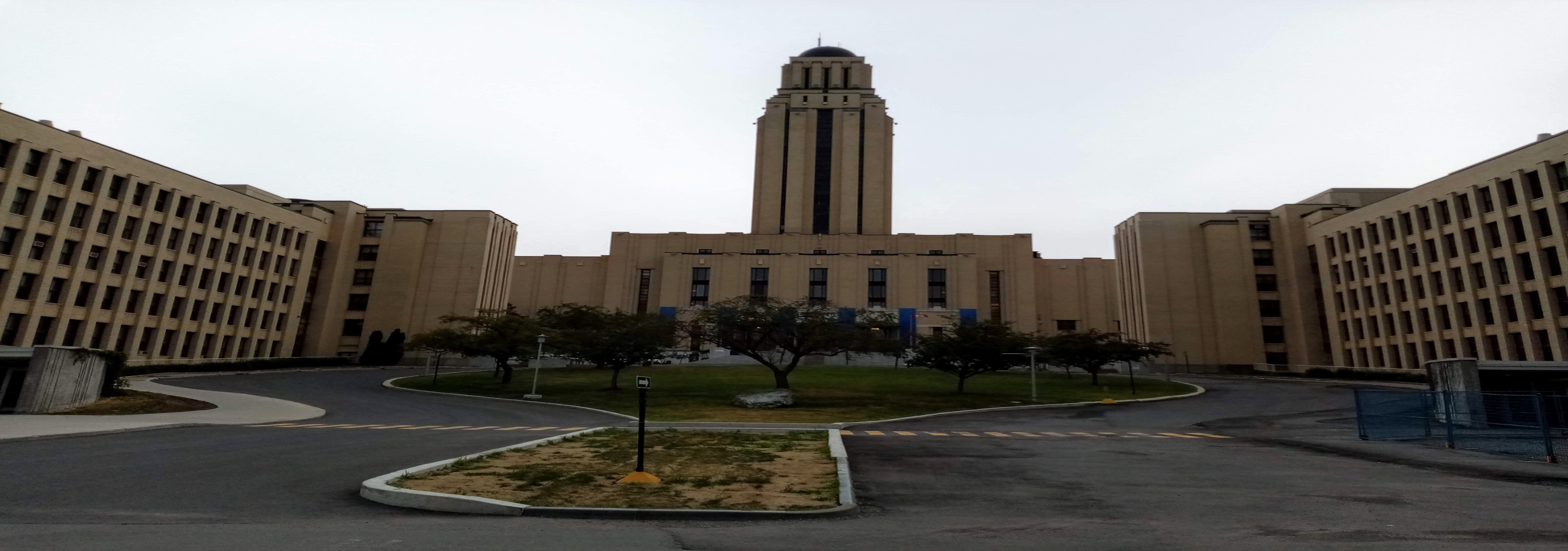
<p>I recently attended the annual running of the <a href="https://www.smb.org/" target="_blank">Society for Mathematical Biology</a> conference, <a href="http://smb2019.org" target="_blank">SMB2019</a>. This years edition was held on the campus of the <a href="https://www.umontreal.ca/en/" target="_blank">Université de Montréal</a> from 22nd-26th July.</p>

<p>The theme for the conference was "From genome to biome.". The full programme (with abstracts) may be viewed <a href="https://edmhill.github.io/files/Programmes/SMB2019AbstractBooklet.pdf" target="_blank">here</a>.</p>

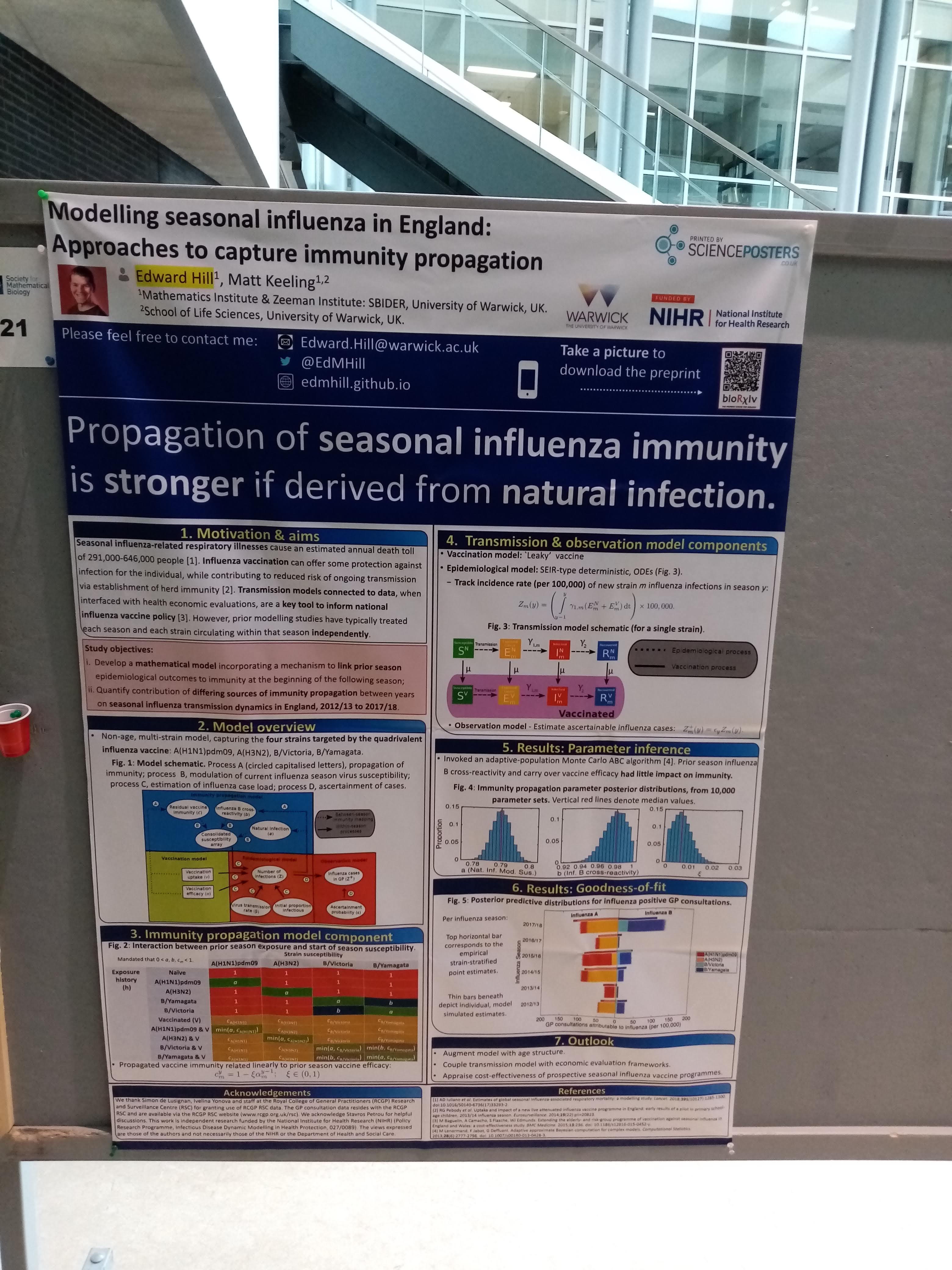
<p>My own contribution in the meeting was a poster on "Modelling seasonal influenza in England: Approaches to capture immunity propagation".</p>

<figure>
  <img src="/images/SMB2019/MySMB2019PosterPhoto.jpg" alt="SMB2019 poster" />
      <figcaption> Our work on modelling seasonal influenza in England displayed in poster form!</figcaption>
</figure>

<h3 id="mentoring-programme">Mentoring programme</h3>

<p>A strength of the SMB annual meeting is the provision of a mentorship programme, where junior scientists can request to be matched with a senior scientist. I enrolled onto the mentoring programme as both a mentor and a mentee. Overall, I found the programme rewarding and would encourage others to be involved in mentoring schemes when offered at scientific meetings!</p>

<p>To flesh out the details on what the mentorship scheme entails, an outline is given in the <a href="https://www.smb.org/mentorship-program/" target="_blank">mentorship pages of the SMB website</a>:</p>

<p>"Junior scientists can request to be matched with a senior scientist. Junior scientists include students (both undergraduate and graduate), postdoctoral fellows, research assistants, newly appointed faculty members, etc. Senior scientists include postdoctoral fellows, research assistants, faculty members, etc. Because of the overlap in our definitions of junior and senior scientists, some individuals may sign up both as a mentee and a mentor."</p>

<p>Throughout the duration of the conference, the membership program encourages the following types of interactions:</p>

<ul>
  <li>mentors introduce mentees to their colleagues to help the mentee establish a professional network;</li>
  <li>mentors and mentees spend a lunch or dinner together discussing the mentees’ educational and/or career objectives;</li>
  <li>mentors share their career experience with their mentees;</li>
  <li>mentors attend the (poster or lecture) presentation of the mentee and provide constructive feedback;</li>
  <li>mentors spend some time explaining how conference presentations relate to each other, or how they fit into "the bigger picture".</li>
</ul>

<p>Additionally, the mentor and mentee research interests can reside in different disciplines, with the participants common interest in the interface of mathematics and biology being the driving factor for fruitful and mutually beneficial interactions.</p>

<p>My mentee was <a href="https://cco.oden.utexas.edu/members/kaitlyn-johnson/" target="_blank">Kaitlyn Johnson</a>, a third year PhD candidate in a Biomedical Engineering PhD program at <a href="https://cco.oden.utexas.edu" target="_blank">The Center for Computational Oncology</a>, <a href="https://www.utexas.edu" target="_blank">University of Texas at Austin</a>.</p>

<p>Kaitlyn’s work involves integrating experimental data into mathematical models of tumour growth and drug resistance. She is a member of <a href="http://www.brocklab.com" target="_blank">the Brock Lab</a>, a lab investigating the role of heterogeneity in cell state transitions, cancer progression, and therapeutic responses.</p>

<p>During the conference, Kaitlyn presented both a poster and a talk on "An integrated approach to calibrate and validate mathematical models of therapy-induced resistance from in vitro drug response data in cancer".</p>

<h3 id="smb--esmtb-joint-meeting-2020">SMB &amp; ESMTB joint meeting 2020</h3>

<p>Looking ahead, the next SMB annual meeting will be a joint meeting with the <a href="https://www.esmtb.org" target="_blank">European Society of Mathematical and Theoretical Biology (ESMTB)</a>; the venue for the joint meeting is Heidelberg, Germany, taking place from 31st August-4th September 2020.</p>]]></content><author><name>Ed Hill</name><email>Edward.Hill@liverpool.ac.uk</email></author><category term="SMB2019" /><category term="conference" /><summary type="html"><![CDATA[]]></summary></entry><entry><title type="html">Mood: Interdisciplinary Perspectives, New Theories</title><link href="https://edmhill.github.io/posts/mood_volume/" rel="alternate" type="text/html" title="Mood: Interdisciplinary Perspectives, New Theories" /><published>2019-05-09T00:00:00+01:00</published><updated>2019-05-09T00:00:00+01:00</updated><id>https://edmhill.github.io/posts/MoodVol</id><content type="html" xml:base="https://edmhill.github.io/posts/mood_volume/"><![CDATA[<figure>
  <img src="/images/MoodBook/featured.jpg" alt="" />
</figure>

<p>The study of mood has gathered sustained academic interest in recent years across a variety of academic disciplines (philosophy, psychology, linguistics, life sciences, to name but a few). Though each individual discipline furthers our understanding of mood, by its nature of intersecting several research fields mood lends itself to being studied in an interdisciplinary way. To bridge the gap between discipline-specific approaches to mood, concerted efforts need to be made.</p>

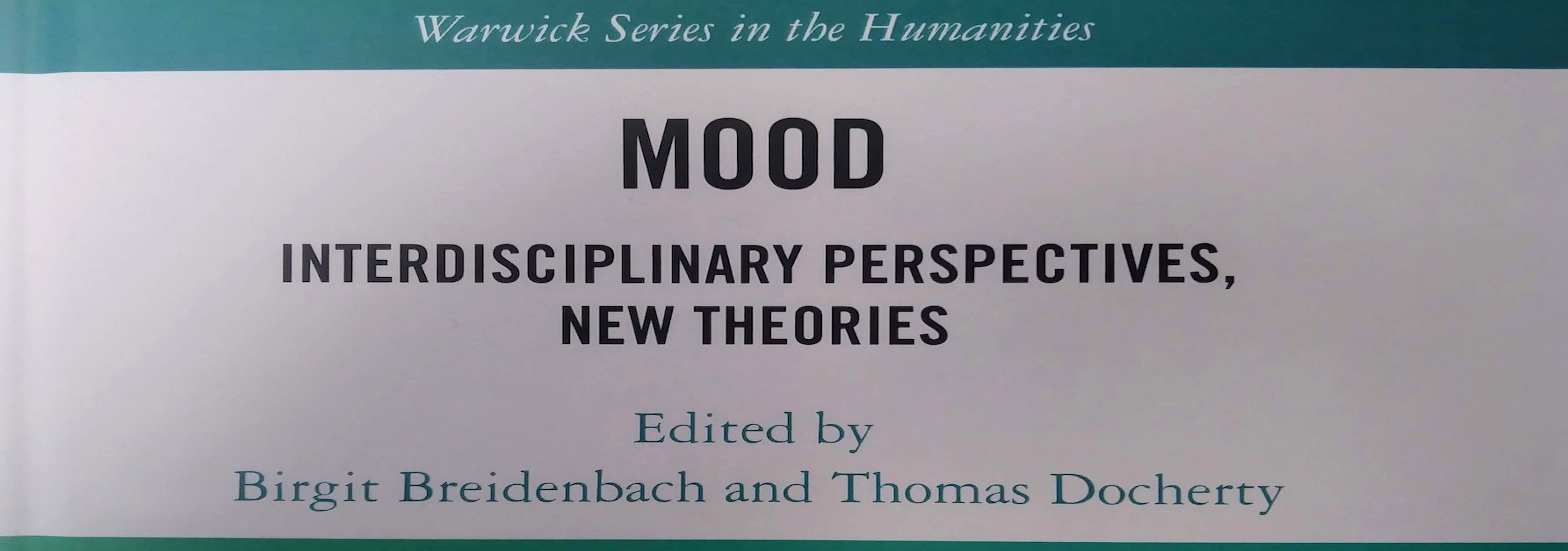
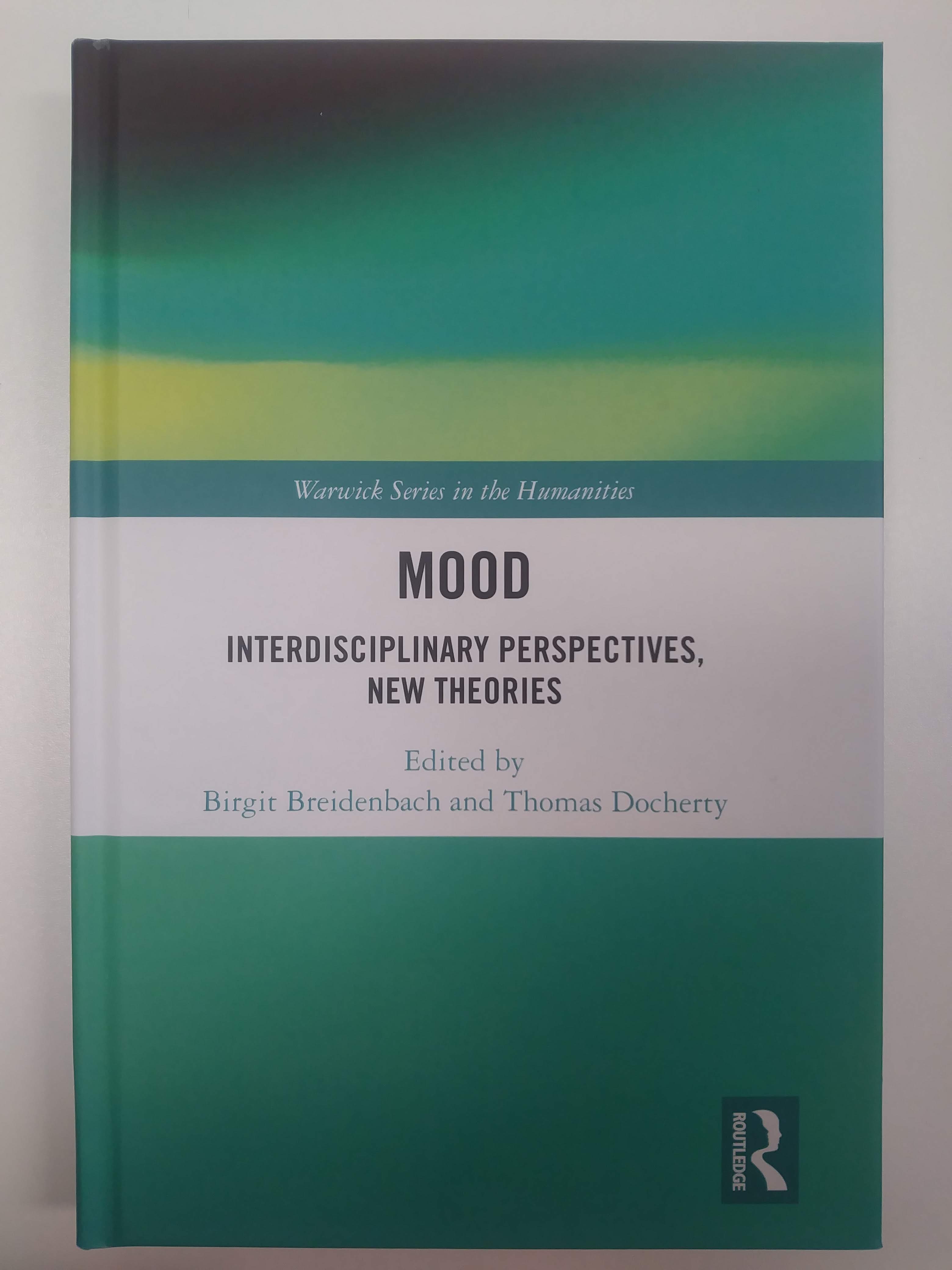
<p>It was therefore pleasing both myself and my collaborator <a href="https://personalpages.manchester.ac.uk/staff/thomas.house/about.html" target="_blank">Thomas House (School of Mathematics, The University of Manchester)</a> were approached by <a href="https://people.uea.ac.uk/b_breidenbach" target="_blank">Birgit Breidenbach (Lecturer in Literature and Philosophy, University of East Anglia)</a> and <a href="https://warwick.ac.uk/fac/arts/english/people/dochertyprofthomas/" target="_blank">Thomas Docherty (Research Professor of English and of Comparative Literature, University of Warwick)</a>, editors of a book volume on <a href="https://www.routledge.com/Mood-Interdisciplinary-Perspectives-New-Theories-1st-Edition/Breidenbach-Docherty/p/book/9780367200664" target="_blank"><em>Mood: Interdisciplinary Perspectives, New Theories</em></a>, offering us an opportunity to contribute a piece giving a mathematical modelling and epidemiological perspective on examining mood.</p>

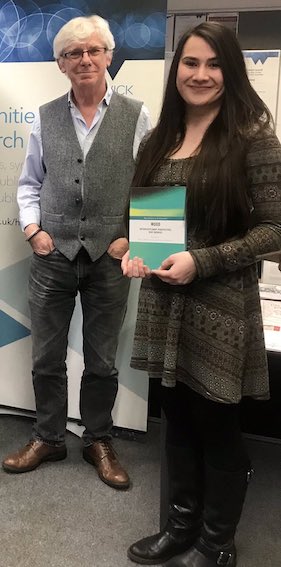
<p>The volume was published in April 2019 by Routledge in the <a href="https://www.routledge.com/Warwick-Series-in-the-Humanities/book-series/WSH" target="_blank"><em>Warwick Series in the Humanities</em></a>, which focuses on interdisciplinary work on major collaborative topics in the humanities, social sciences and sciences. The volume is also available as an <a href="https://www.taylorfrancis.com/books/9780429259432" target="_blank">eBook</a>.  On 9th May 2019, the volume was showcased as part of a <a href="https://warwick.ac.uk/fac/arts/hrc/events/bl/" target="_blank">Humanities Book Launch</a> hosted by the <a href="https://warwick.ac.uk/fac/arts/hrc/" target="_blank">Humanities Research Centre</a> at the University of Warwick.</p>

<figure>
  <img src="/images/MoodBook/MoodVolCover.jpg" alt="Mood volume cover photo" align="left" width="59%" />
  <img src="/images/MoodBook/HRCEventPhoto.jpeg" alt="HRC book launch" width="39%" />
      <figcaption> <b> (Top) </b>  Front cover of <i> Mood: Interdisciplinary Perspectives, New Theories </i>  <b> (Bottom) </b> Birgit Breidenbach and Thomas Docherty with the published volume at the Humanities Book Launch event. </figcaption>
</figure>

<h3 id="origins-of-the-volume-and-content-overview">Origins of the volume and content overview</h3>

<p>Though not the case for our chapter, the vast majority of the chapters in the volume originated from a collection of papers delivered at the conference <a href="https://warwick.ac.uk/fac/arts/english/research/conferences/mood2016/" target="_blank"><em>Mood: Aesthetic, Psychological and Philosophical Perspectives</em></a>, held at The University of Warwick in 2016.</p>

<p>The objective of the conference was to explore the interdisciplinary potential in the study of mood and facilitate dialogue between disciplines. The result has been several contributions to the volume making a conscious effort to bridge disciplinary gaps in approaching mood.</p>

<p>Across the chapters, the authors engage with the phenomenon of mood in new and innovative ways, recognising the interdisciplinary challenge that mood poses. Perspectives from several fields are given, including philosophy, architecture, musicology, mathematical epidemiology, medicine, classics, translation studies, and literary studies.</p>

<h3 id="modelling-the-spread-of-mood">Modelling the spread of mood</h3>

<p>In the chapter contributed by myself and Thomas (House), we present the methodology and results of two studies investigating whether contagiousness of positive and negative moods spread within adolescent friendship networks in a contagion-like manner. The studies and data collected shed light on the complex relationship between individual and social mood and enable a better understanding of mood from an epidemiological perspective with possible applications within the health-care sector.</p>

<p>For further information on these studies, please view the project page on <a href="https://edmhill.github.io/project/socialcontagion/" target="_blank">Social Contagion</a>.</p>

<h3 id="reflections-on-the-process">Reflections on the process</h3>

<p>An important part of the writing process was ensuring an interdisciplinary audience would find the piece accessible, to be able to fully appreciate the depth and implications of the work. Reframing our existing research into a less technical and more discursive form was a challenging but rewarding experience.</p>

<p>The drafting and revisions of the work were helped immensely by the fantastic editorial guidance provided by Birgit and Thomas (Docherty), which greatly enhanced the narrative and readability of the chapter. Another highly enjoyable aspect of the collaboration was having collective discussions about the volume as a whole and hearing their personal perspectives on the study of mood.</p>

<p>As a concluding comment, if presented with a chance to disseminate your research outside your primary research discipline, I would definitely advocate pursuing such an opportunity.</p>]]></content><author><name>Ed Hill</name><email>Edward.Hill@liverpool.ac.uk</email></author><category term="Mood volume" /><summary type="html"><![CDATA[]]></summary></entry><entry><title type="html">IDDconf 2018</title><link href="https://edmhill.github.io/posts/IDDConf2018/" rel="alternate" type="text/html" title="IDDconf 2018" /><published>2018-09-06T00:00:00+01:00</published><updated>2018-09-06T00:00:00+01:00</updated><id>https://edmhill.github.io/posts/IDDConf2018</id><content type="html" xml:base="https://edmhill.github.io/posts/IDDConf2018/"><![CDATA[<figure>
  <img src="/images/IDDConf2018/featured.jpg" alt="" />
</figure>

<p>From 3rd-5th September 2018 I attended <a href="http://iddconf.org" target="_blank">IDDconf 2018: A Conference on Infectious Disease Dynamics</a> held at the <a href="https://www.cumbria.ac.uk/student-life/locations/ambleside/" target="_blank">Ambleside Campus, University of Cumbria</a>.</p>

<p>IDDconf 2018 was the second instalment of a new meeting series focussing on innovative research in infectious disease dynamics. Organised by the <a href="http://cmmid.lshtm.ac.uk" target="_blank">Centre for Mathematical Modelling of Infectious Diseases</a> at the <a href="https://www.lshtm.ac.uk" target="_blank">London School of Hygiene &amp; Tropical Medicine</a>, IDDconf provides a fairly small (~100 participants), community-driven conference, to improve interaction between modellers.</p>

<h3 id="the-scientific-programme">The scientific programme</h3>

<p>The programme consisted of a single-stream of 44 short talks (12 mins in length &amp; 3 mins for questions), with a small poster session during the evening reception on the opening day.</p>

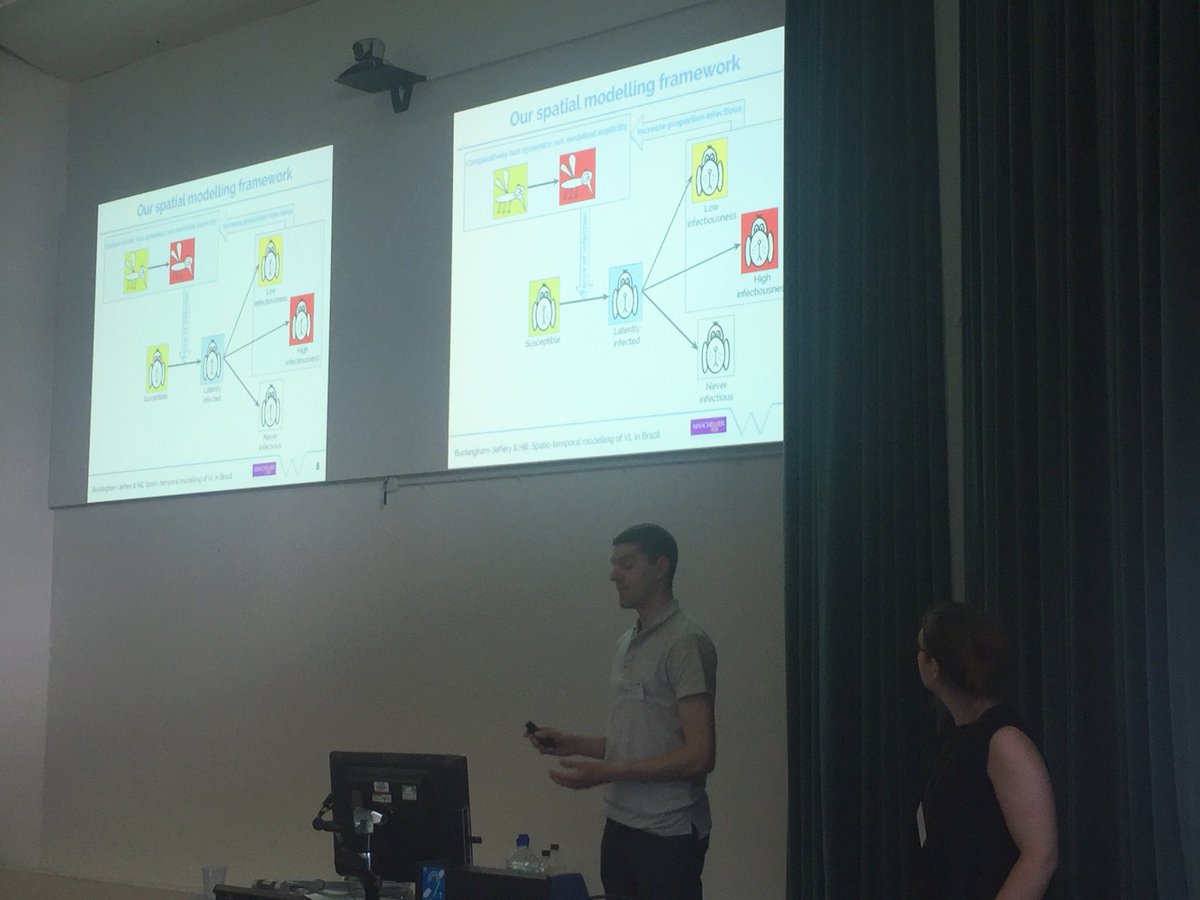
<p>A novel aspect is those wishing to present a talk only need to submit a title, with talk selection done randomly. Myself and <a href="https://ebucksjeff.github.io" target="_blank">Elizabeth Buckingham-Jeffery</a> had the opportunity to present a joint talk on our collaborative work "Spatio-temporal modelling of visceral leishmaniasis among domestic dogs in rural Brazil".</p>

<figure>
  <img src="/images/IDDconf2018/LizEd_TalkPhoto.jpg" alt="Presenting photo" />
      <figcaption> Photo courtesy of Sophie Meakin, taken during our presentation.</figcaption>
</figure>

<h3 id="sbider-involvement">SBIDER involvement</h3>

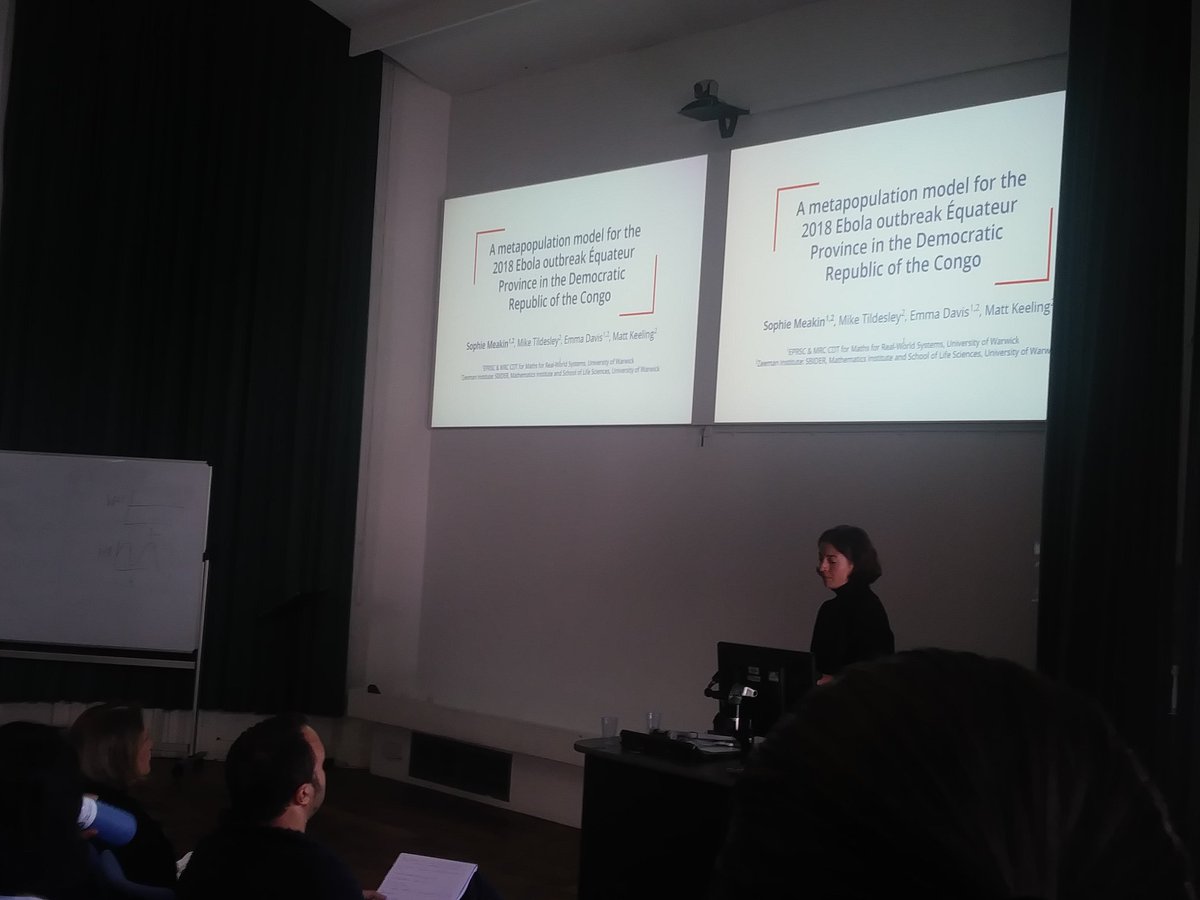
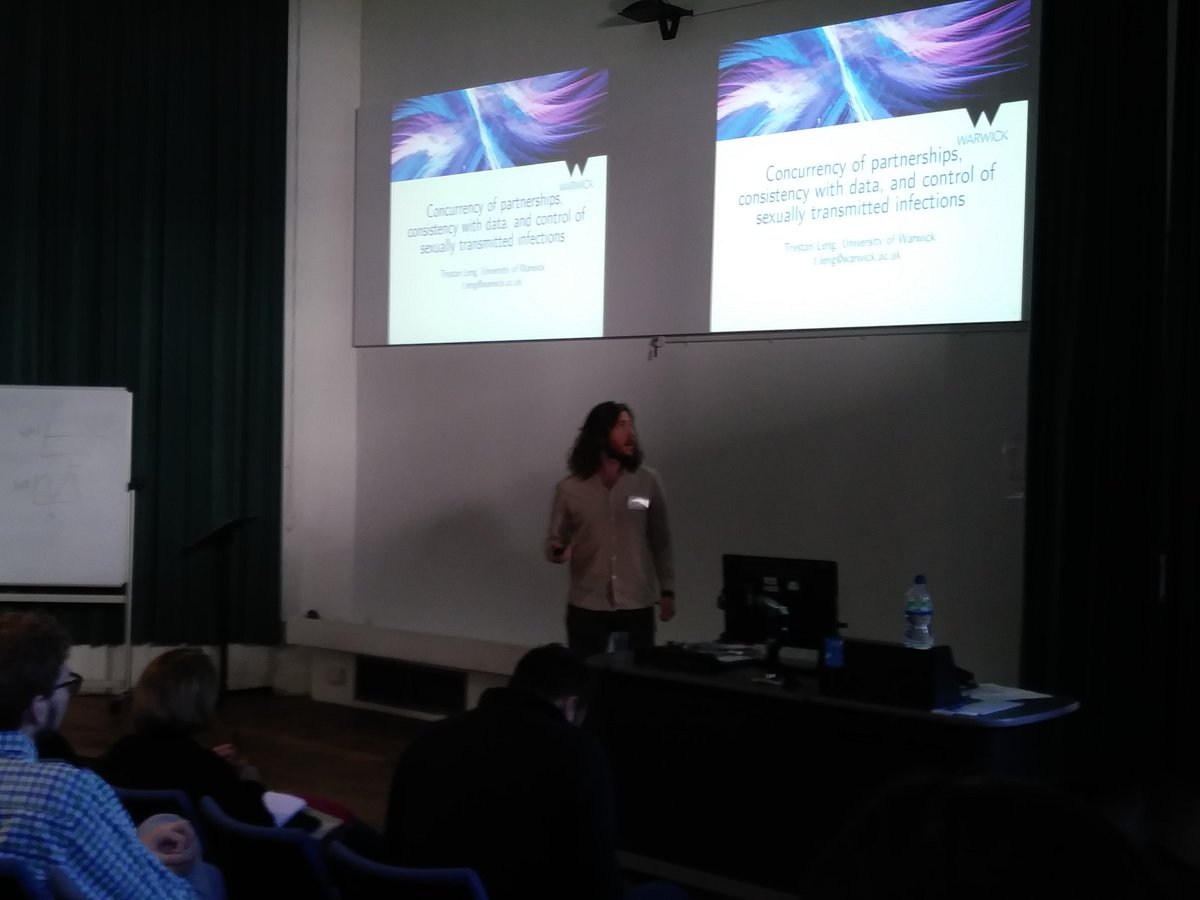
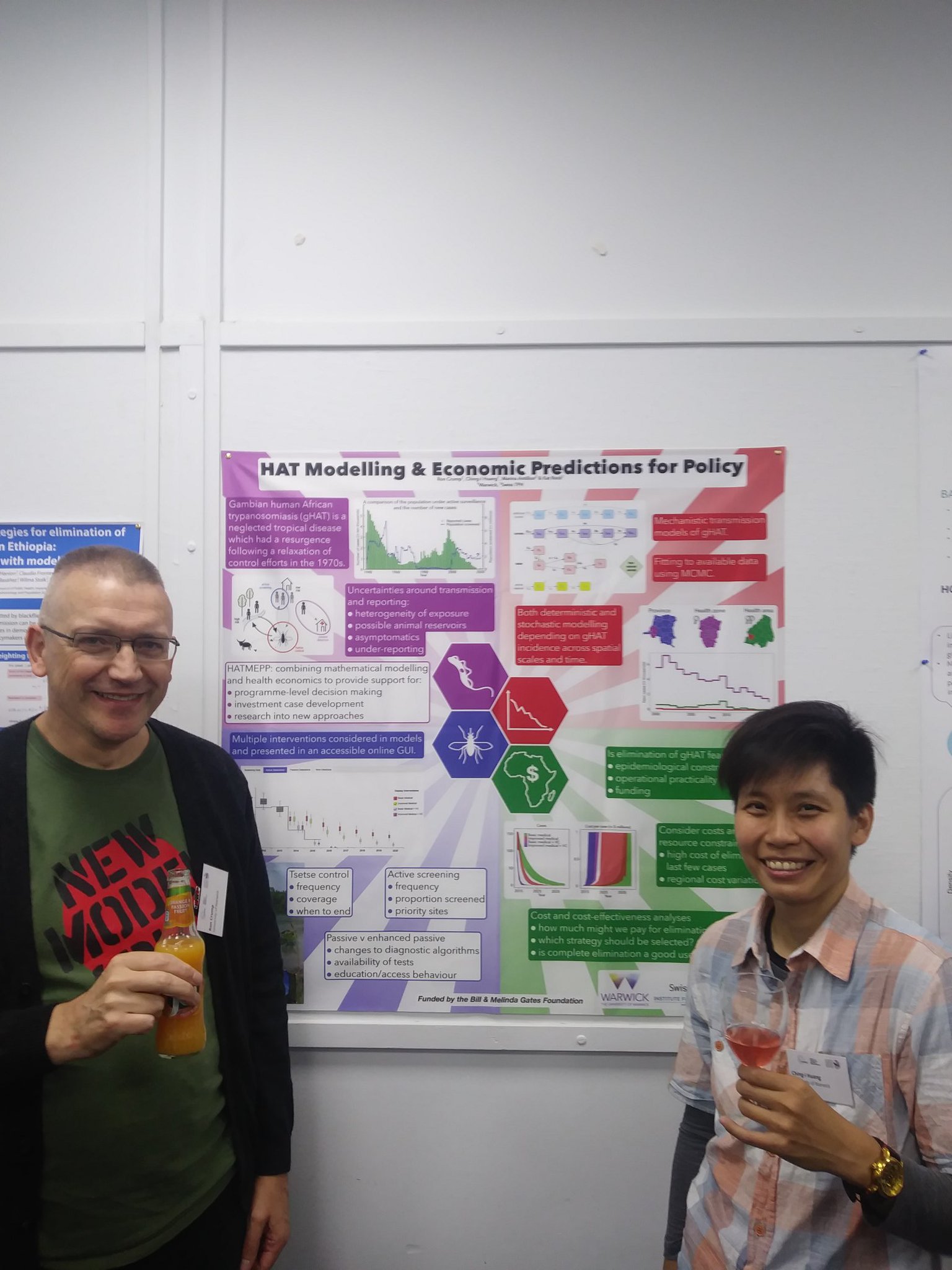
<p>A number of students and staff were present from the <a href="https://warwick.ac.uk/fac/cross_fac/zeeman_institute/" target="_blank">SBIDER group</a>, with talk and poster contributions pictured below.</p>

<figure>
    <img src="/images/IDDconf2018/SophieTalk.jpg" alt="Presenting photo" align="left" width="50%" />
        <img src="/images/IDDconf2018/TrystanTalk.jpg" alt="Presenting photo" width="50%" />
      <img src="/images/IDDconf2018/HATposter.jpeg" alt="Presenting photo" width="100%" />
        <img src="/images/IDDconf2018/ChrisTalk.jpg" alt="Presenting photo" align="left" width="40%" />
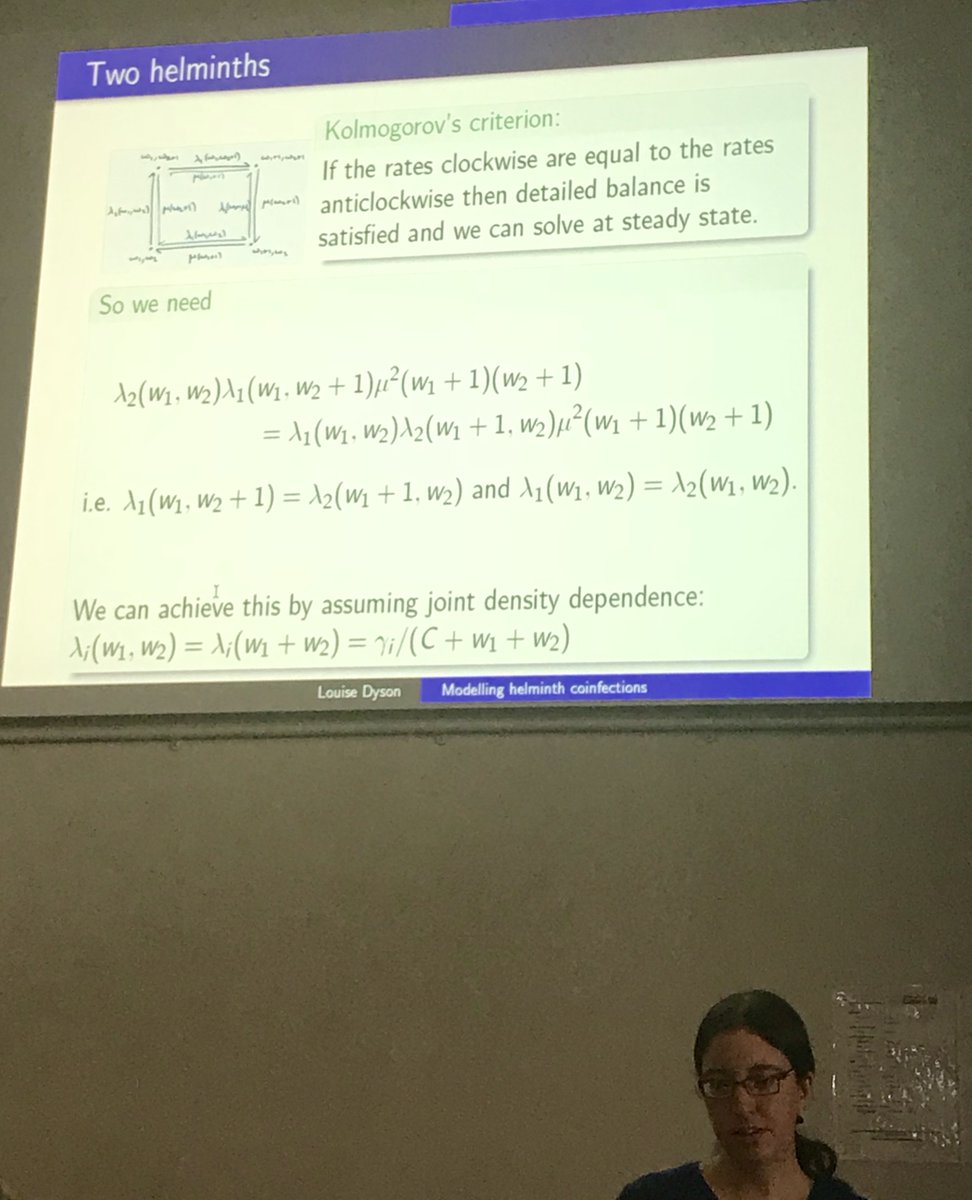
    <img src="/images/IDDconf2018/LouiseTalk.jpg" alt="Presenting photo" width="60%" />

      <figcaption>
      <b>  (Top row) <i> Sophie Meakin  </i> </b> - &quot;A metapopulation model for the 2018 Ebola outbreak in the Democratic Republic of the Congo&quot;; <br />
       <b>  (Second row) <i> Trystan Leng </i> </b>  - &quot;Concurrency of partnerships, consistency with data, and control of sexually transmitted infections&quot;; <br />
        <b> (Third row) <i>  HAT MEPP project poster </i> </b>  - Pictured are team members are Ron Crump and Ching-I Huang ; <br />
        <b> (Fourth row) <i>  Chris Davis </i> </b>  - &quot;Village-scale elimination of HAT (gambiense human African trypanosomiasis)&quot;;  <br />
        <b>  (Bottom row) <i> Louise Dyson </i> </b>   - &quot;Modelling helminth coinfections&quot;;.<br />
      </figcaption>
</figure>

<p>Further news from the SBIDER group may be found on its <a href="https://warwick.ac.uk/fac/cross_fac/zeeman_institute/" target="_blank">webpage</a> and <a href="https://twitter.com/WarwickSBIDER" target="_blank">twitter profile (@WarwickSBIDER)</a>.</p>

<h3 id="social-programme">Social programme</h3>
<p>The second afternoon was allocated as free time, with many attendees spending the afternoon going on walks in the Lake District countryside.</p>

<figure>
  <img src="/images/IDDconf2018/VillagePhoto.jpg" alt="Village photo" />
</figure>]]></content><author><name>Ed Hill</name><email>Edward.Hill@liverpool.ac.uk</email></author><category term="IDDConf2018" /><category term="conference" /><summary type="html"><![CDATA[]]></summary></entry><entry><title type="html">ECMTB 2018</title><link href="https://edmhill.github.io/posts/ECMTB2018/" rel="alternate" type="text/html" title="ECMTB 2018" /><published>2018-07-29T00:00:00+01:00</published><updated>2018-07-29T00:00:00+01:00</updated><id>https://edmhill.github.io/posts/ECMTB2018</id><content type="html" xml:base="https://edmhill.github.io/posts/ECMTB2018/"><![CDATA[<figure>
  <img src="/images/ECMTB2018/featured.jpg" alt="" />
</figure>

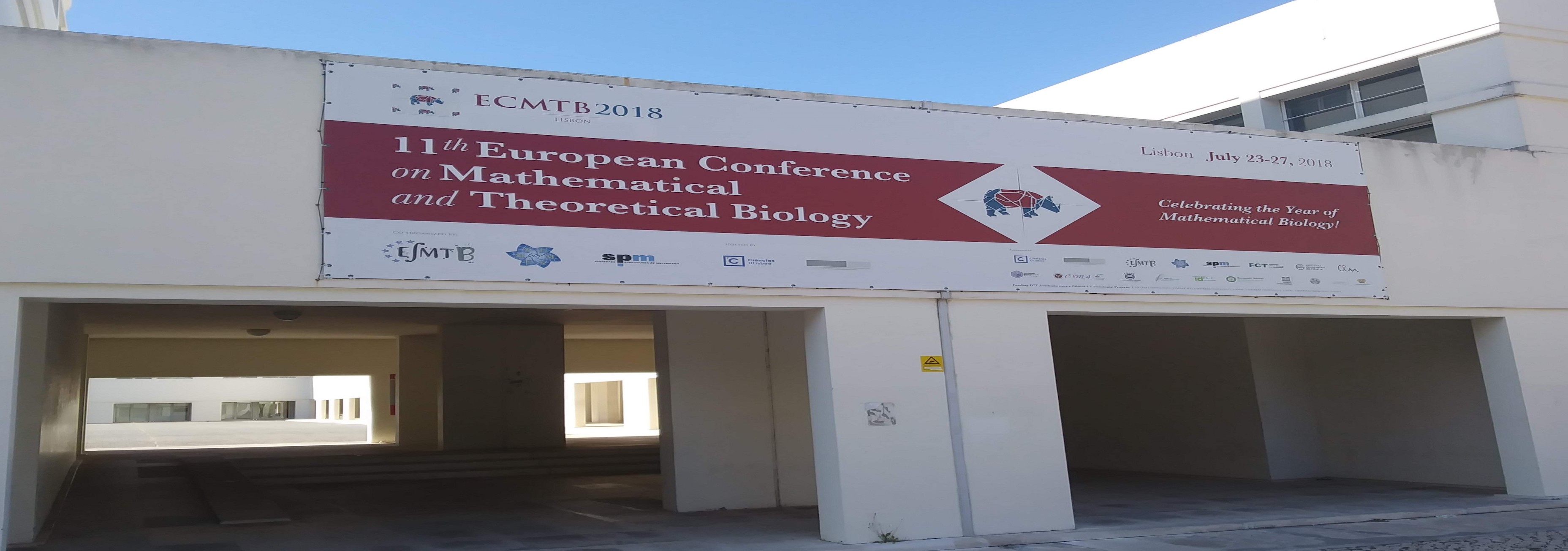
<p>From 23rd-27th July 2018 I attended the <a href="http://www.ecmtb2018.org" target="_blank">11th European Conference on Mathematical and Theoretical Biology (ECMTB)</a> held at the <a href="https://ciencias.ulisboa.pt/en" target="_blank">Faculdade de Ciências da Universidade de Lisboa (Faculty of Sciences of the University of Lisbon)</a>. Co-organised by the <a href="https://www.esmtb.org" target="_blank">European Society for Mathematical and Theoretical Biology (ESMTB)</a>, this meeting was the main event of the <em>Year of Mathematical Biology 2018</em>.</p>

<p>The packed scientific programme comprised 36 Minisymposia, 307 contributed talks and 119 posters.</p>

<h3 id="sbider-involvement">SBIDER involvement</h3>

<p>A number of students and staff were present from the <a href="https://warwick.ac.uk/fac/cross_fac/zeeman_institute/" target="_blank">SBIDER group</a>. <a href="http://www.davidrand.co.uk" target="_blank">Professor David Rand</a> was a speaker at a minisymposium on <em>Multi-scale mathematical models in endocrinology</em>, while contributions amongst a contingent of seven PhD students from the <a href="https://warwick.ac.uk/fac/sci/mathsys/" target="_blank">MathSys DTC</a> included presenting posters and giving presentations within <em>Epidemiology</em> and <em>Immunology</em> contributed talk sessions (pictured below).</p>

<figure>
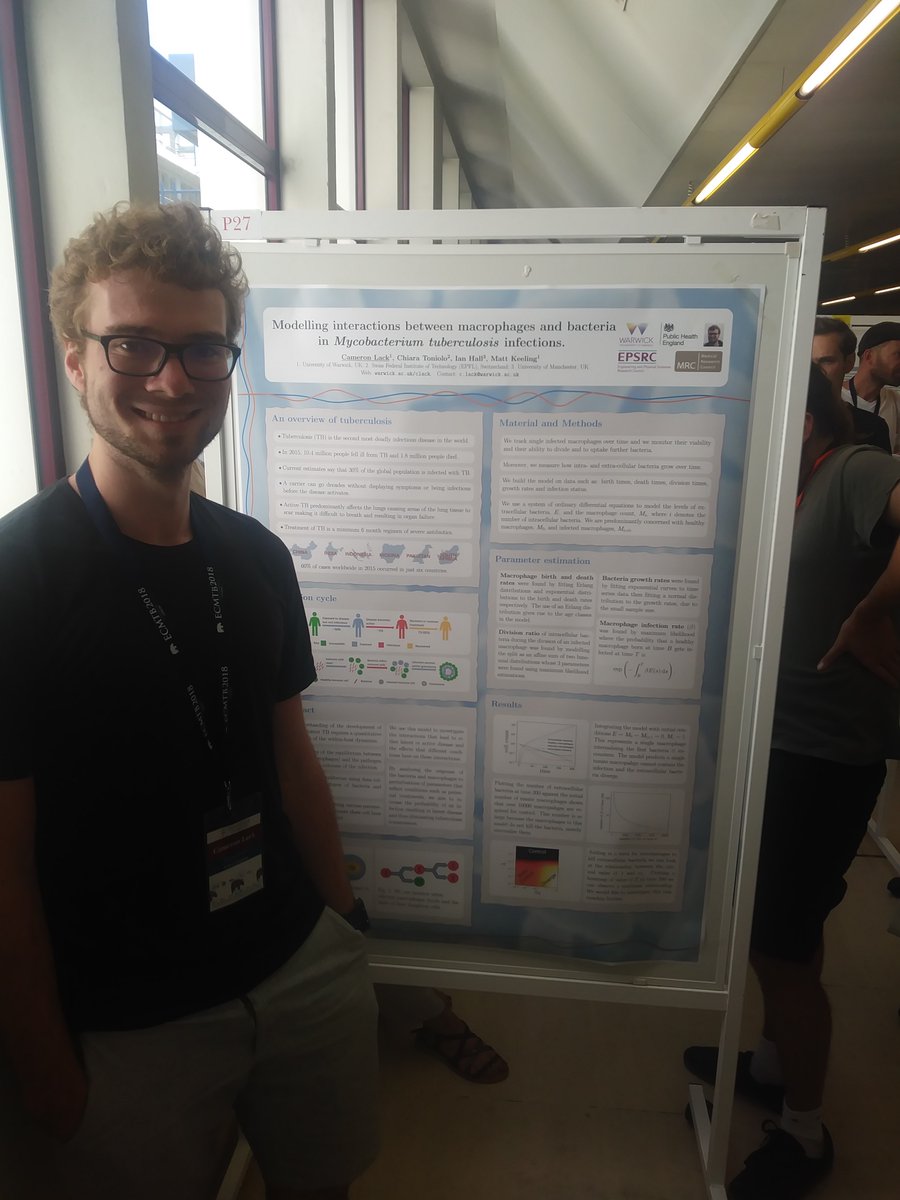
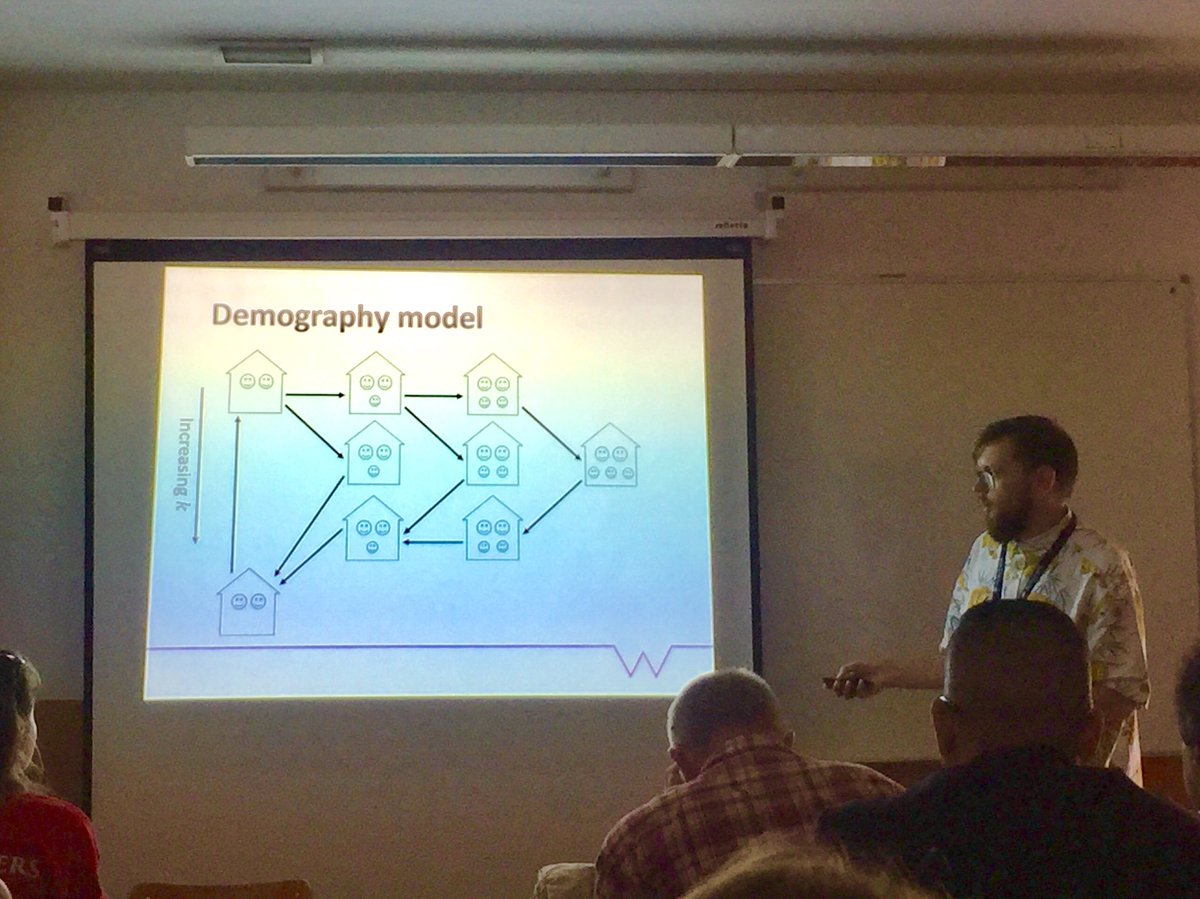
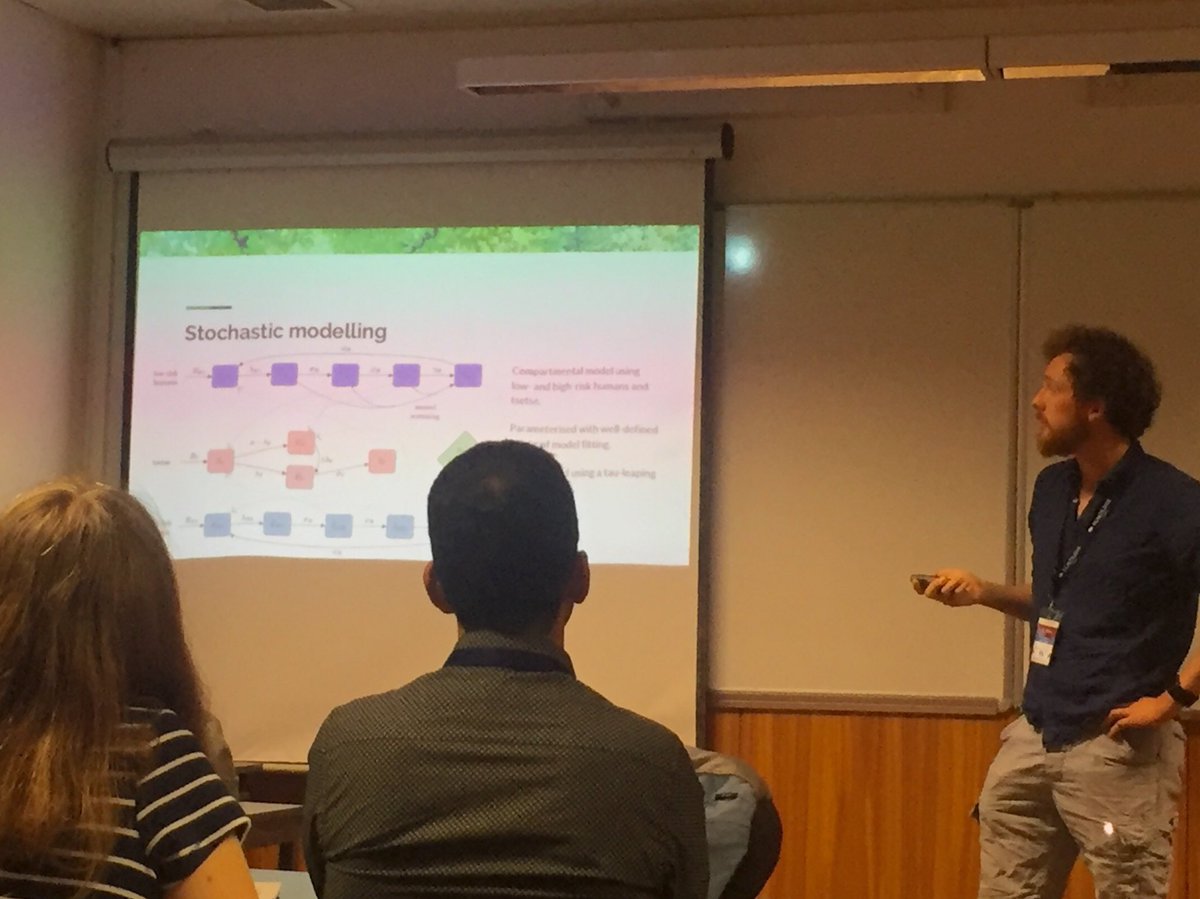
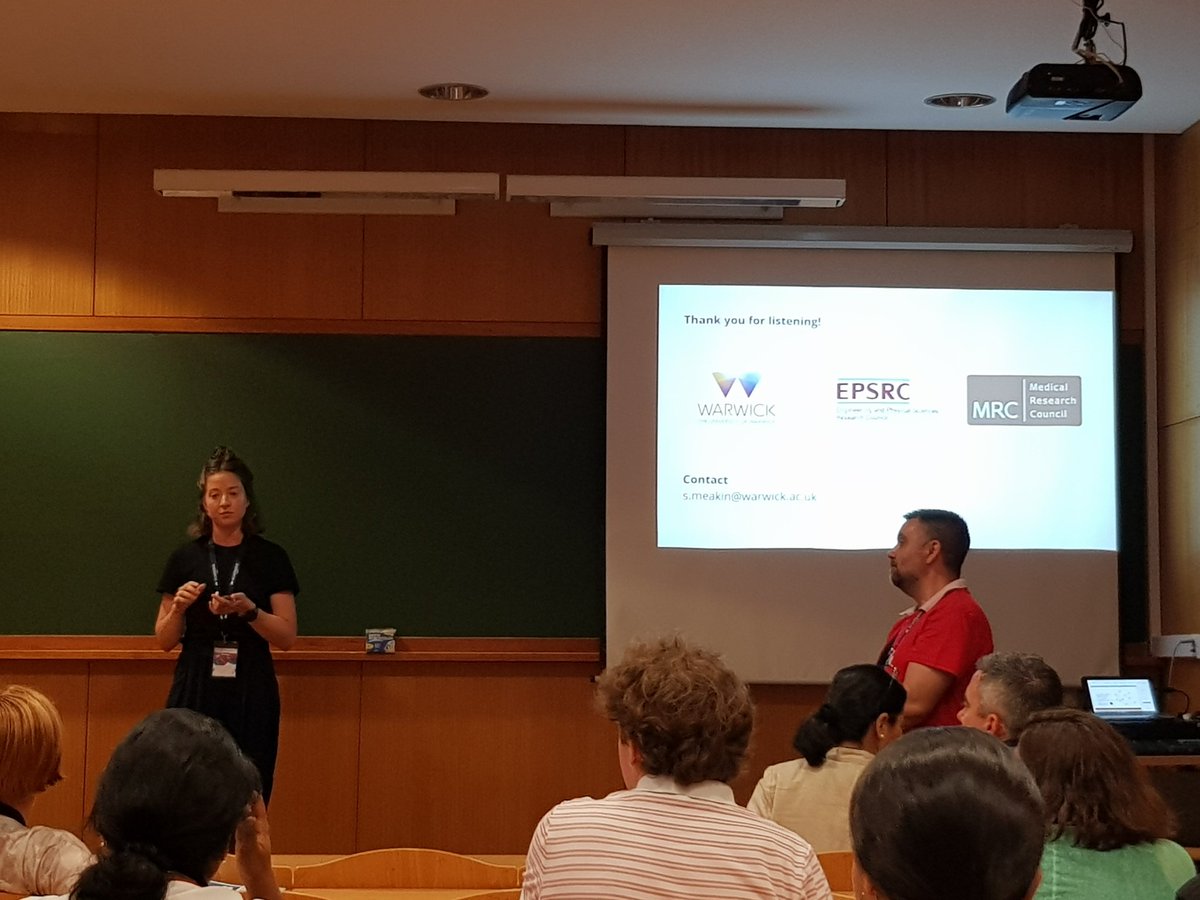
  <img src="/images/ECMTB2018/ECMTB2018_CameronPoster.jpg" alt="Presenting photo" align="left" width="49%" />
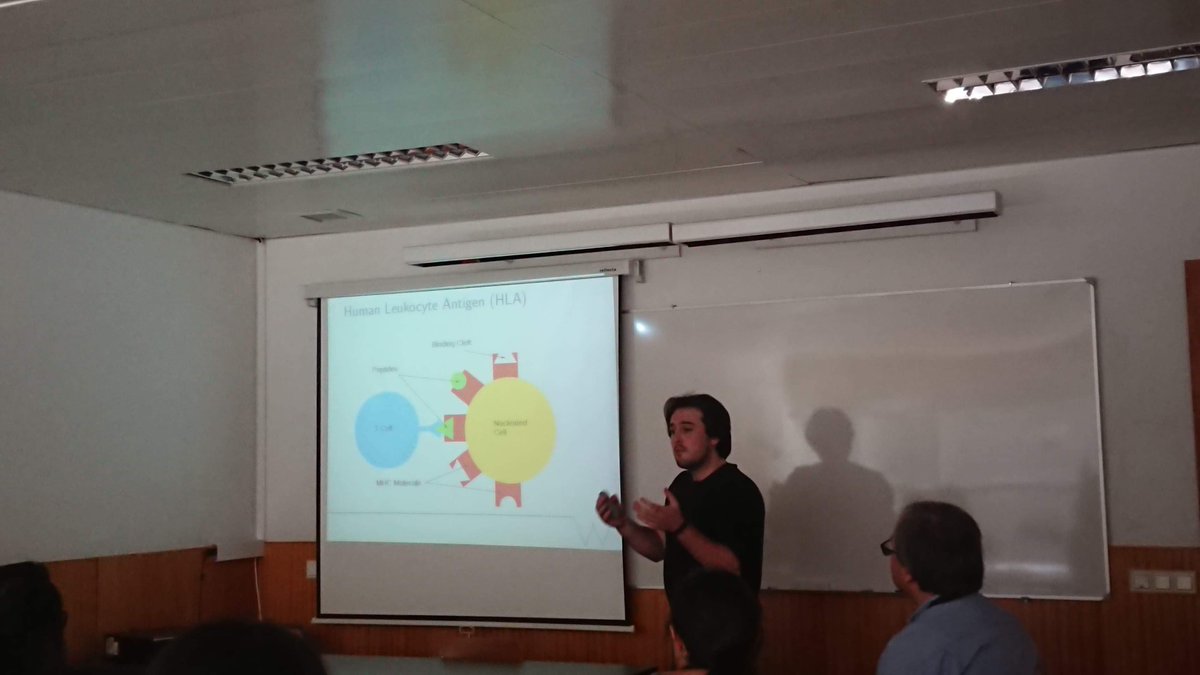
  <img src="/images/ECMTB2018/ECMTB2018_ConnorTalk.jpg" alt="Presenting photo" width="50%" />
    <img src="/images/ECMTB2018/ECMTB2018_JoeTalk.jpg" alt="Presenting photo" align="left" width="50%" />
  <img src="/images/ECMTB2018/ECMTB2018_ChrisTalk.jpeg" alt="Presenting photo" align="left" width="50%" />
    <img src="/images/ECMTB2018/ECMTB2018_SophieTalk.jpg" alt="Presenting photo" width="50%" />

      <figcaption> <b> (Top row) <i>  Cameron Lack </i> </b>  - &quot;Modelling the interactions between macrophages and bacteria in Mycobacterium tuberculosis infections&quot;; <br />
      <b>  (Second row) <i> Connor White </i> </b>   - &quot;The protectiveness of HLA Alleles against infection in the presence of multiple pathogen strains&quot;; <br />
      <b>  (Third row) <i> Joe Hilton </i> </b>  - &quot;Household models for endemic diseases&quot;; <br />
      <b> (Fourth row) <i>  Chris Davis </i> </b>  - &quot;Village-scale persistence and elimination of HAT (gambiense human African trypanosomiasis)&quot;;  <br />
      <b>  (Bottom row) <i> Sophie Meakin  </i> </b> - &quot;Correlations between stochastic epidemics in multiple interacting subpopulations&quot;.
      </figcaption>
</figure>

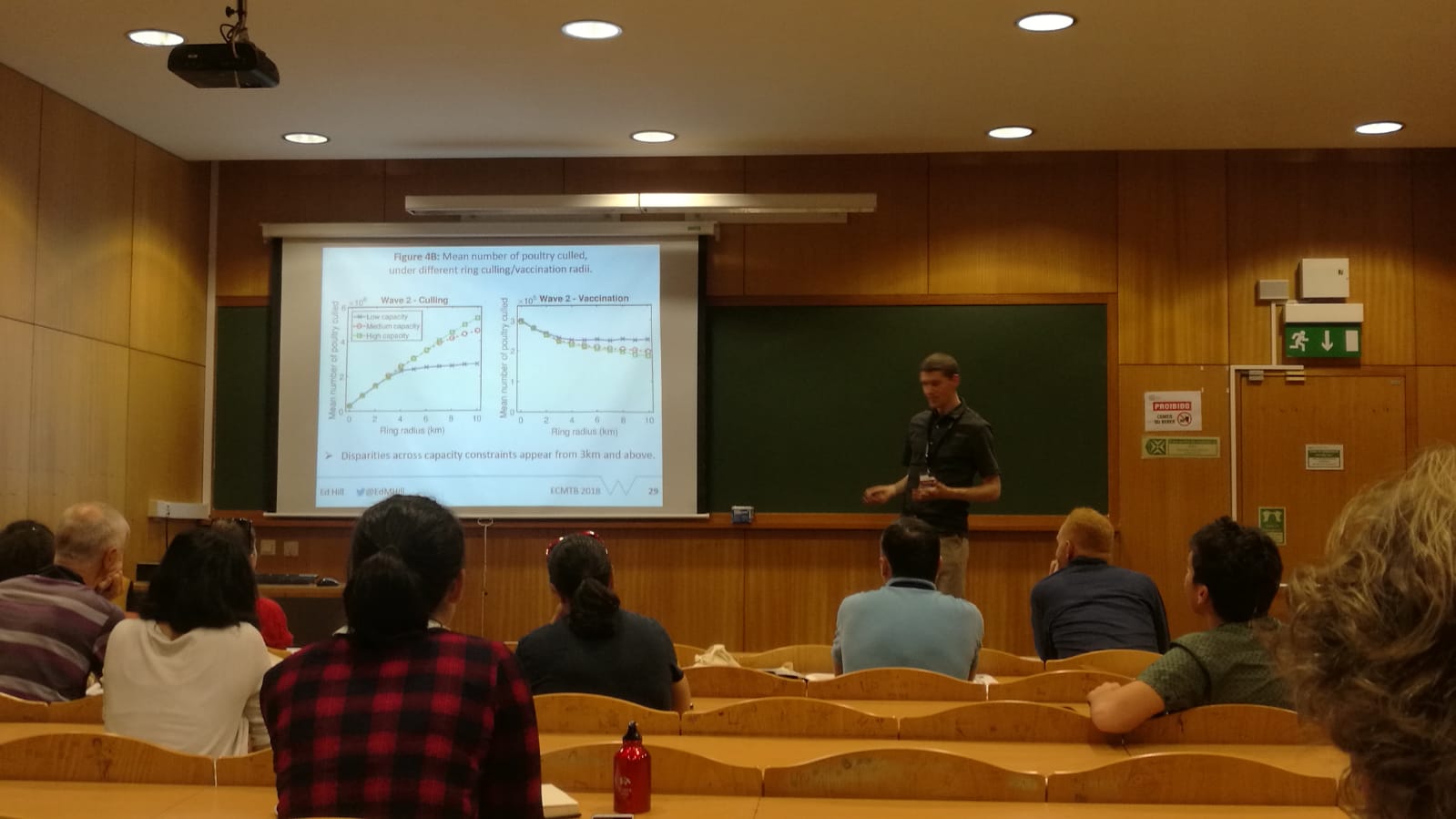
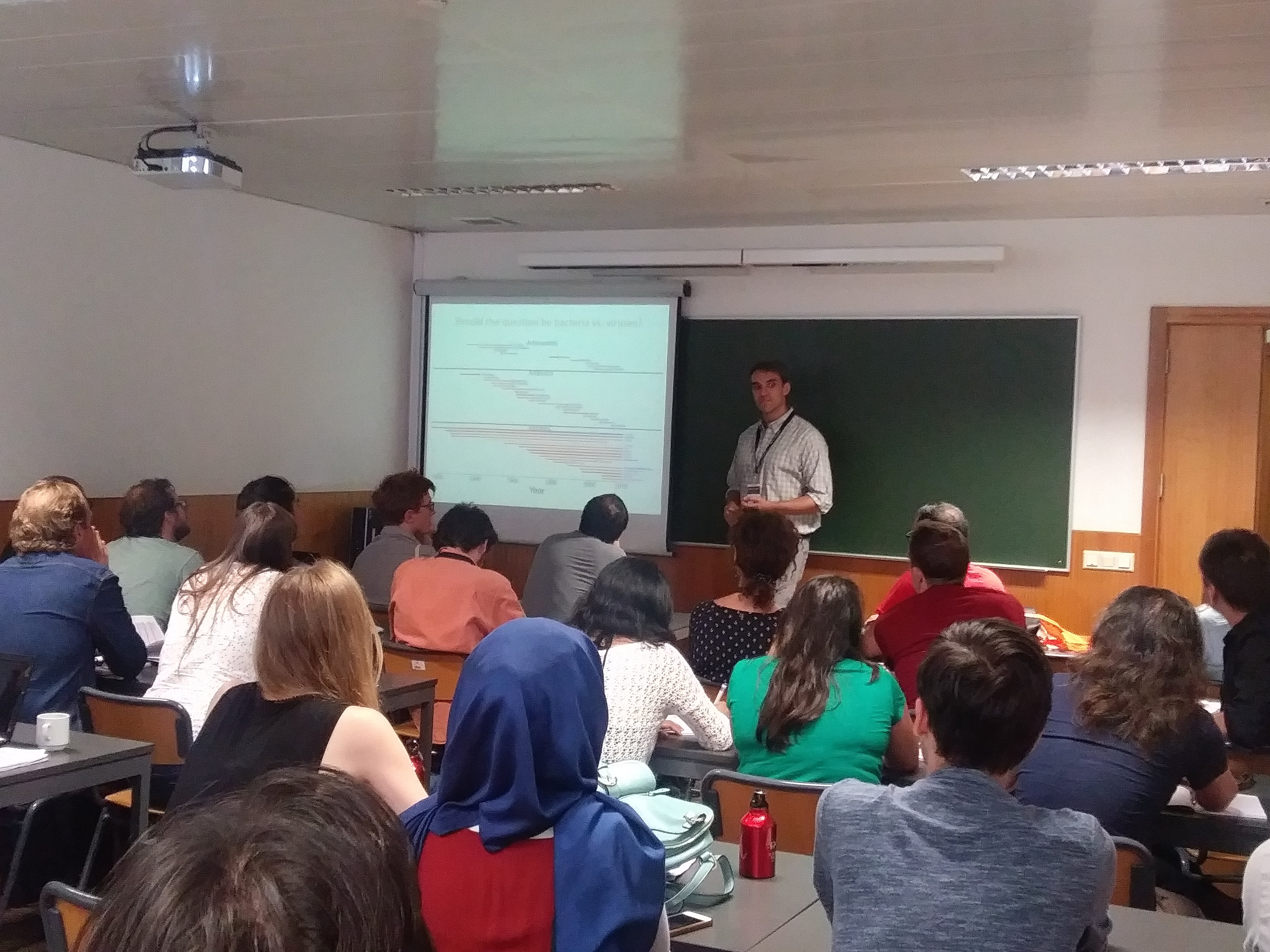
<p>My own contribution was a talk within the <em>Epidemiology I</em> session titled, <em>Assessing intervention responses against H5N1 avian influenza outbreaks in Bangladesh</em>.</p>
<figure>
  <img src="/images/ECMTB2018/LisbonTalkPhoto.jpeg" alt="Presenting photo" />
      <figcaption> Photo courtesy of Ben Atkins, taken during my presentation </figcaption>
</figure>

<p>Further news from the SBIDER group may be found on its <a href="https://warwick.ac.uk/fac/cross_fac/zeeman_institute/" target="_blank">webpage</a> and <a href="https://twitter.com/WarwickSBIDER" target="_blank">twitter profile (@WarwickSBIDER)</a>.</p>

<h3 id="minisymposia">Minisymposia</h3>

<p>Though the talks I attended earlier in the week were primarily part of the contributed track, there were two minisymposia I was present for during the final couple of days of the conference.</p>

<p>On the Thursday, the session <em>‘"How to design evolution-proof public health interventions?"</em> was well-attended and included a talk by <a href="http://www.thereadgroup.net/author/david/" target="_blank">David Kennedy (Penn State University)</a> addressing the question <em>"Why does drug resistance readily evolve but vaccine resistance does not?"</em></p>

<figure>
  <img src="/images/ECMTB2018/DKennedyTalk.jpg" alt="Presenting photo" />
      <figcaption> David Kennedy presenting his talk in the 'How to design evolution-proof public health interventions?' minisymposium </figcaption>
</figure>

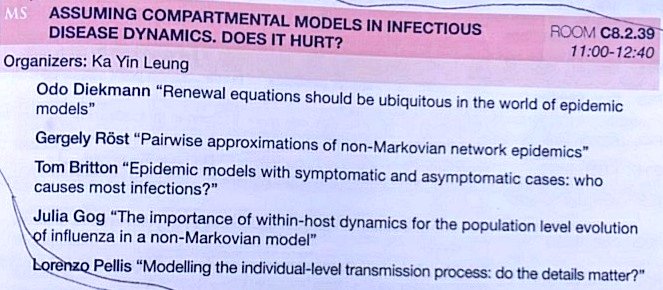
<p>The last day of the conference included a minisymposia organised by <a href="https://www.su.se/profiles/kleun-1.292561" target="_blank">Ka Yin Leung</a> that posed the question <em>"Assuming compartmental models in infectious disease dynamics. Does it hurt?"</em>. The minisymposium lineup was as follows:</p>

<figure>
  <img src="/images/ECMTB2018/MS_schedule.jpeg" alt="Presenting photo" />
</figure>

<h3 id="ecmtb-2020">ECMTB 2020</h3>

<p>Looking ahead, the location of the next event in the series was announced as Heidelberg, Germany, taking place from 3rd-7th August 2020.</p>]]></content><author><name>Ed Hill</name><email>Edward.Hill@liverpool.ac.uk</email></author><category term="ECMTB2018" /><category term="conference" /><summary type="html"><![CDATA[]]></summary></entry><entry><title type="html">SMB 2018</title><link href="https://edmhill.github.io/posts/SMB2018/" rel="alternate" type="text/html" title="SMB 2018" /><published>2018-07-16T00:00:00+01:00</published><updated>2018-07-16T00:00:00+01:00</updated><id>https://edmhill.github.io/posts/SMB2018post</id><content type="html" xml:base="https://edmhill.github.io/posts/SMB2018/"><![CDATA[<figure>
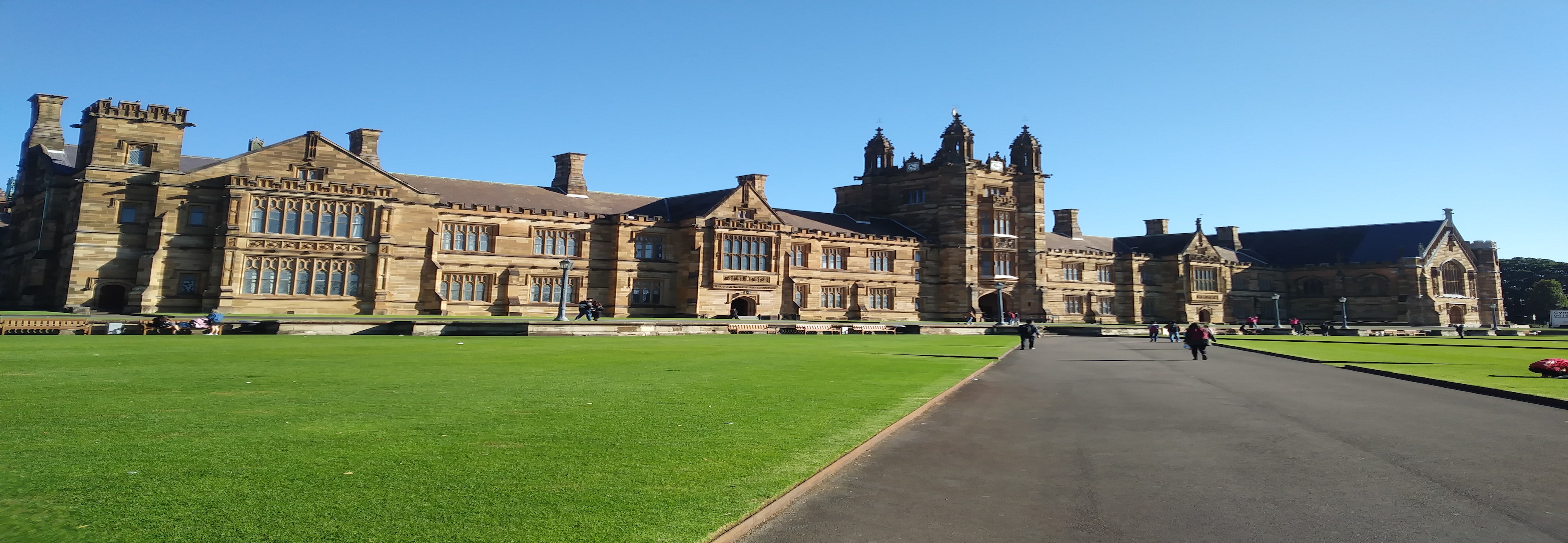
  <img src="/images/SMB2018/featured.jpg" alt="The Main Quadrangle of the University of Sydney." />
      <figcaption> The Main Quadrangle of the University of Sydney. </figcaption>
</figure>

<p>I recently attended the annual running of the <a href="https://www.smb.org/" target="_blank">Society for Mathematical Biology</a> conference, <a href="https://www.smb2018.org" target="_blank">SMB2018</a>. This years edition was held at the <a href="https://sydney.edu.au/" target="_blank">University of Sydney</a> from 8th-12th July 2018.</p>

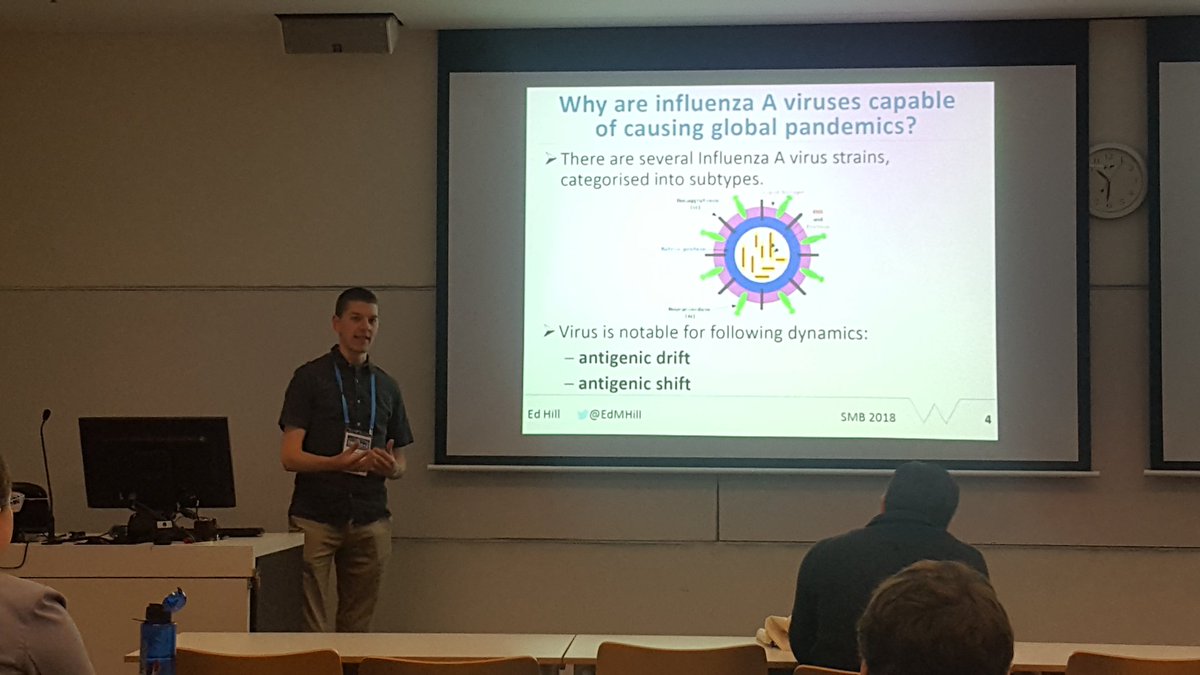
<p>It was a thoroughly enjoyable event and a valuable opportunity to interact with colleagues from the international mathematical biology community. I was pleased to have the opportunity to present a contributed talk, <em>Evidence for history-dependence of influenza pandemic emergence</em>, in the <em>Epidemiology: Part B</em> parallel session.</p>
<figure>
  <img src="/images/SMB2018/MyTalkPhoto.jpg" alt="Presenting photo" />
      <figcaption> Photo courtesy of Alexandra Hogan, taken during my presentation </figcaption>
</figure>

<p>Here, I outline a few points from the series of plenary talks:</p>

<p>The epidemiology themed plenary talk was titled <em>Modelling immunity:a multi-scale problem</em>, delivered by <a href="http://immune.math.yorku.ca/jmheffer/" target="_blank">Jane Heffernan</a>, director of the <a href="http://yihr.info.yorku.ca/centre-for-disease-modeling/" target="_blank">Centre for Disease Modelling (CDM)</a> at <a href="https://www.yorku.ca/index.html" target="_blank">York University</a>. The multiple scales referred to in the talk title are how infectious diseases affect individuals (immunology) and populations (epidemiology). Mathematical models that link the in-host and populations scales of infection can better inform public health programs, although a drawback of immuno-epidemiological models are that they can rapidly become very complex. The talk discussed immunological, epidemiological and immuno-epidemiological modelling studies, applied to a breadth of infectious diseases including influenza, HIV, measles and pertussis.</p>

<p><a href="http://www.jenniferflegg.com.au" target="_blank">Jennifer Flegg</a> (<a href="https://www.unimelb.edu.au" target="_blank">University of Melbourne</a>) gave a nice overview of mathematical models developed for wound healing and the biological impact they have made. Jennifer’s own research is aimed at informing clinical treatment of non-healing wounds be devising governing equations which capture the essential behaviour of the complex system.</p>

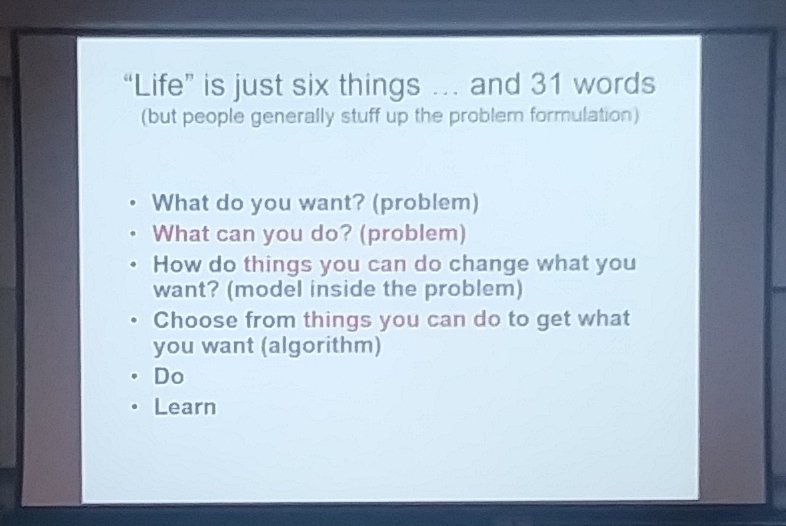
<p>Conservation had prominent presence throughout the conference, with <a href="https://www.nature.org/science-in-action/our-scientists/chief-scientist-hugh-possingham.xml" target="_blank">Hugh Possingham</a> presenting <em>How mathematics can be used in nature conservation</em>. Hugh is Chief Scientist at <a href="https://www.nature.org/?intc=nature.tnav.logo" target="_blank">The Nature Conservancy</a>, an organisation addressing the most pressing conservation threats at the largest scale. The talk provided a variety of examples of how operations research and ecological modelling has formulated and solved pressing conservation problems - from locating places for national parks to saving threatened species. For its message and conciseness, I particularly liked the concluding slide from the plenary talk by Hugh, summarising the modelling cycle:</p>
<figure>
  <img src="/images/SMB2018/PlenarySlide.jpg" alt="Presenting photo" />
</figure>

<p>The final plenary of the conference was delivered by <a href="http://www.math.canterbury.ac.nz/~a.james/" target="_blank">Alex James</a> (<a href="http://www.canterbury.ac.nz" target="_blank">University of Cantebury</a>). Walking through the history of foraging theory, I was unaware levy walks had dominated mathematical descriptions of foraging since the mid-1990s. She concluded by stating that although power laws are incredibly useful, they probably are not in the context of foraging.</p>]]></content><author><name>Ed Hill</name><email>Edward.Hill@liverpool.ac.uk</email></author><category term="SMB 2018" /><category term="conference" /><summary type="html"><![CDATA[]]></summary></entry></feed>